Revenue management is often assumed to be the preserve of large hotel chains, but for small hotels with few rooms, each room's pricing decision has an even more direct impact on overall revenue—and the cost of mispricing or leaving a room empty is higher too. The good news: adopting revenue management no longer requires expensive systems or a dedicated team——with AI tools and consulting services, even small hotels with limited manpower can price precisely. This article explains why small hotels need revenue management even more, how to choose a tool or service, and what the actual adoption process looks like.
Key Takeaways
- The fewer the rooms, the heavier each room weighs on total revenue, and the greater the cost of mispricing or an empty room——small hotels actually can afford "gut-feel pricing" even less than big hotels
- The biggest hidden cost of pricing by experience is missing peak-season demand surges while doing more wasted work at low prices in the off-season
- Adopting revenue management doesn't require building your own team or weeks of setup. With AI tools and consultants, even small hotels with limited manpower can afford it
- When choosing a revenue management tool or service, focus on: whether it integrates with your PMS, whether it factors in competitors and local events, whether it's low-maintenance, and how quickly you can get up to speed
- Real case: the 10-room Hotel K Yuzawa chose to build a revenue management team together with mrhost, growing booking-website revenue 70.8% year over year
1. Why does "fewer rooms" make revenue management even more necessary?
Many small-hotel operators think: "I only have a dozen or twenty rooms; I'll just take a look each day and price by experience—do I really need revenue management?"
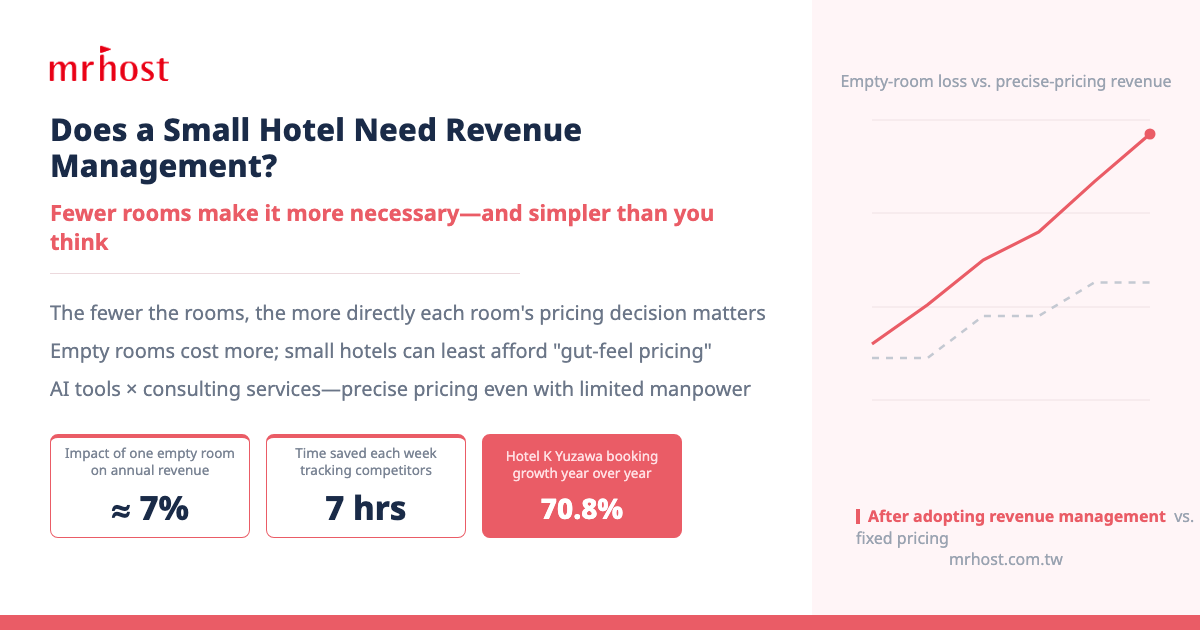
This intuition is actually backwards. The fewer the rooms, the heavier each room weighs on total revenue. For a 15-room hotel, failing to sell one room means losing 1/15 of that day's revenue; the same empty room is just 0.5% for a 200-room hotel, but nearly a 7% hit for a small hotel. In other words, small hotels cannot afford the cost of "mispricing" or "leaving a room empty," and every room's pricing decision matters even more.
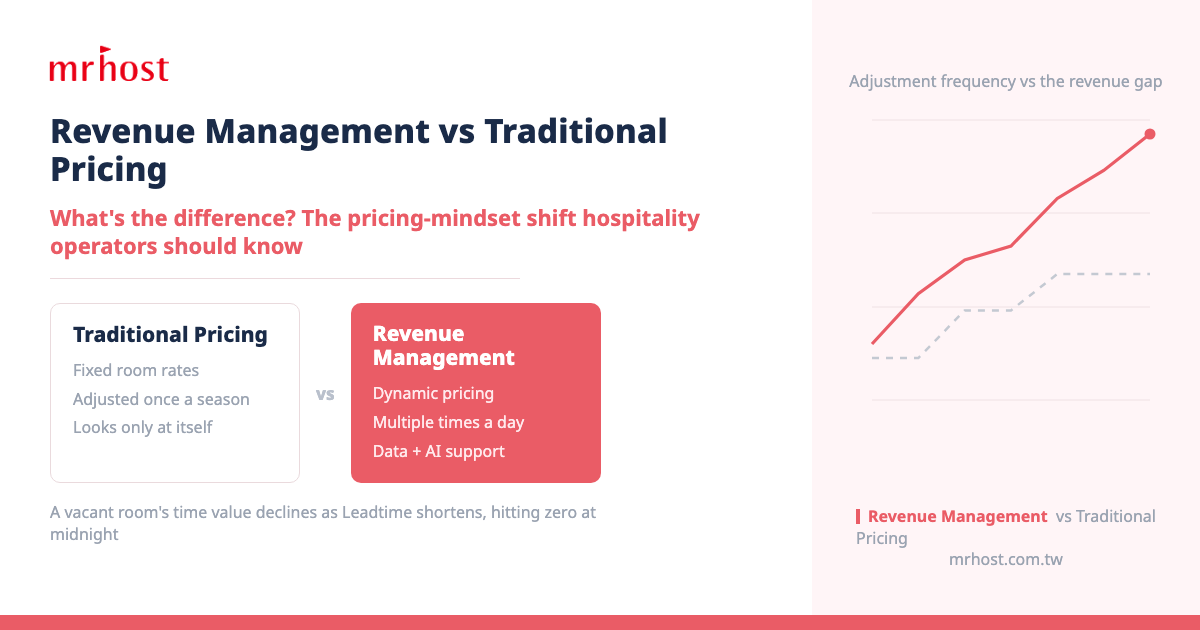
On top of that, small hotels often have pronounced seasonal swings and lack the cushion of brand recognition, so earning less in peak season and sitting on empty rooms in the off-season feeds straight into that month's profit and loss. This is exactly the core problem revenue management solves——getting every room sold at the most suitable price before its time value drops to zero.
2. What is pricing by experience costing you?
Small-hotel owners usually wear many hats: front desk, finance, marketing, and sometimes housekeeping too. Amid all of this, "changing the room rate" easily gets pushed to last, even when you know adjusting prices could earn more.
The problem is that the loss from experience-based, fixed pricing is "invisible." The cost of a complaint is clear——the guest is unhappy, leaves a negative review, demands a refund; but the loss from not adjusting rates with demand is easily overlooked because "how much more you could have earned" is hard to estimate. There are two specific aspects:
Missing demand peaks. During long weekends, school holidays, local events, and sporting events or concerts, travelers' demand and willingness to pay both rise. If your rates don't keep up, you leave money you could have earned on the table.
Doing more, earning less. This is an extension of the previous point. Do the math and it's clear: selling 12 rooms at NT$2,000 versus 8 rooms at NT$3,000 both yield NT$24,000 in revenue, but the former adds 4 more rooms to clean, supply, power, and staff. Using low prices to push occupancy in the off-season looks like a full house, but the profit gets eaten up by costs.
3. What changes when you adopt revenue management?
When rates follow the market, small hotels see three changes:
Higher revenue per available room (RevPAR). No more selling too cheap in peak season or pricing yourself out of competitiveness in the off-season. Capture the rate you deserve on high-demand days, and chase bookings to fill gaps on low-demand days.
Saving the time spent watching the market daily. Paired with an automated dynamic pricing system, the system suggests rates and the operator only needs to accept or adjust them—no need to do market research and rate comparisons by hand every day.
Pricing with evidence, not gut feel. Every rate corresponds to market demand, competitor rates, and your own occupancy, rather than guesswork, giving operators more confidence in their pricing.
4. How should a small hotel choose a revenue management tool or service?
There are plenty of options out there; you can judge them with the following questions:
Does it integrate with your property management system (PMS)? This is the key to automation. Only by integrating with the PMS can a tool automatically pull room-status data and push adjusted rates back to each platform. The revenue management system (RMS) pushes prices and the PMS pushes inventory; linking the two is what automates work that was previously manual.
Does it explain its pricing recommendations? A good tool doesn't just give a number; it also explains the reasoning behind it (demand, competitor rates, remaining rooms), so you can judge whether to adopt it.
Does it factor in competitor rates and local events, or only occupancy? Occupancy is just one piece. Competitors' real-time rates, local events, and special occasions equally affect demand; recommendations that account for all of them are more complete.
Is it low-maintenance and quick to get up to speed? The point of adopting it is to save time, so understand how much manual effort it actually takes once live. Ideally you shouldn't need to hire dedicated staff for it, nor spend weeks on setup before you can start.
If you want the answer to all these questions to be "yes" but don't have the manpower to operate the tool yourself, commissioning a revenue management consultancy is the most practical choice for a small hotel——a consultant paired with AI tools takes over the whole set of tasks above.
5. Real case: how the 10-room Hotel K Yuzawa made its choice
Located in Echigo-Yuzawa, Niigata, Japan, Hotel K Yuzawa is a 10-room boutique hotel. It faces exactly the situation typical of small hotels: Echigo-Yuzawa has pronounced seasonal swings, with fierce competition and rapid price fluctuations in the snow season, while it must maintain occupancy in the off-season—making profit control on every booking critical.
Representative Director and President Ken points to a pain point common to small hotels: "There's no time to research and track competitors' pricing, and even with the data, it's unclear how to use it." Before opening, he made a key decision——to build a revenue management team together with mrhost: he reasoned that, compared with spending high cost and time cultivating an in-house team, partnering directly with a professional team was the wiser investment.
The results of the partnership (case data for this hotel): booking-website revenue grew 70.8% year over year in the 2025–2026 snow season, and off-season occupancy improved markedly; on the manpower side, he estimated that if he handled the work himself, he would spend at least 7 more hours a week on competitor research and rate changes—for a 10-room hotel, that's almost like losing a stretch of time each day for taking care of guests.
What best illustrates the value of "dynamic pricing" is an episode at the end of the snow season: in the third week of March 2026, bookings were originally sparse; Ken held several events alongside the smart pricing system's dynamic adjustments and filled the rooms within a week——and, as Ken says, the average rate he actually achieved was not lowered much; it was in fact higher than expected.
(This is the case experience and data of Hotel K Yuzawa, reflecting its individual experience and not implying all users will achieve the same results. See the full story in the further reading at the end of the article.)
6. Small hotels best suited to adopt revenue management first
The following types of small hotels usually see the most obvious benefits from adopting revenue management:
- Hotels with large seasonal swings: such as scenic-area or resort-style small hotels, with plenty of room to raise the average daily rate (ADR) in peak season and chase bookings in the off-season
- Hotels listed on multiple OTA platforms: multi-platform upkeep is complex and most needs systematic management to keep rates consistent across platforms
- Hotels short on manpower with staff wearing many hats: most need tools and consultants to fill the manpower gap of watching the market daily
- Hotels in fiercely competitive districts: competitor rates change fast and need to be kept up with in real time
- Hotels facing staff turnover: when the person originally in charge of pricing leaves, stable external support is needed to take over
(Guesthouses similar in room type and scale are equally suited to the approaches above.)
Frequently Asked Questions (FAQ)
Q: Does a small hotel really need revenue management?
A: Yes, even more than a big hotel does. The fewer the rooms, the more directly each room's pricing decision affects overall revenue, and the higher the cost of mispricing or an empty room. Small hotels can't afford these losses and need precise pricing all the more to maximize the revenue of every room.
Q: I only have a dozen rooms and two or three room types—do I need it too?
A: Yes. No matter how simple the room types, each type still has different demand and clientele, and with rates to sync across multiple OTAs and your own website, the management complexity is far from low. Few rooms doesn't mean simple pricing; rather, every decision matters more.
Q: I'm short on manpower and can't watch the market and adjust rates daily—what do I do?
A: This is exactly where small hotels are best suited to partner with a consultant. You can build a team together with a revenue management consultancy, where the consultant pairs with a dynamic pricing system to adjust rates by real-time data and help interpret the market, so the operator doesn't have to watch the market daily or build an in-house team from scratch.
Q: Can a small hotel afford the cost of adopting revenue management?
A: Pricing models vary by provider, so it's best to consult directly to find a plan that fits your scale. With AI tools and consulting services, revenue management is no longer exclusive to big hotels; small hotels can adopt it at a reasonable cost too.
Q: Will revenue management take away my control over rates?
A: No. Revenue management provides data analysis and pricing recommendations; the final target occupancy and pricing strategy (prioritizing brand strength, revenue maximization, or aggressive pricing) still rest with the owner, and the consultant's role is to help you make better-informed decisions.
This article was written by the mrhost revenue management team. mrhost provides hospitality revenue management consulting services, helping hotels and guesthouses in Taiwan and the Asia-Pacific region boost revenue and competitiveness.