
Revenue management is the practice of using market data, dynamic pricing, and multi-channel distribution to sell each room to the right guest, at the right time, and at the right price — maximizing a property’s total revenue. A complete revenue management service usually covers four pillars: OTA platform management, a dynamic pricing system, direct-booking growth, and a dedicated consultant. This guide explains what each pillar does and its value, helping hoteliers decide whether they need revenue management.
1. What is revenue management?
Whether you run a hotel, a B&B, or a boutique property, you likely face sharp peak-and-off-season swings and intense competition. How well you use revenue management to grow income has become decisive for success.
The core idea of revenue management is to treat every room as a “perishable product.” A room not sold tonight cannot be sold tomorrow — its value drops to zero that day. So the job of revenue management is to use data analysis and dynamic pricing to sell every room at the most suitable price before it “expires.”
Concretely, revenue management handles two things at once: price (how much each room sells for) and inventory (when, through which channel, and to which type of guest it is sold). When both are well managed, a hotel can lift occupancy in the low season, raise rates in peak season, and — through professional revenue management — lower overall marketing cost, so revenue rises noticeably. In places with strong seasonality or fierce competition, the effect is greater still.
So what does a genuine revenue management service look like, and how does the right pricing work help hoteliers grow revenue? The four pillars below — platform management, a dynamic pricing system, direct-booking growth, and a dedicated consultant — explain its substance and value.
2. The four pillars of a revenue management service
1. Platform management: raise OTA visibility and conversion
Platform management means analyzing travelers’ booking behavior and market trends to build more competitive rate strategies and promotions that draw more potential guests to click and book — effectively raising visibility on OTAs (online travel agencies) — while lowering operating cost through tools such as multi-night and non-refundable plans.
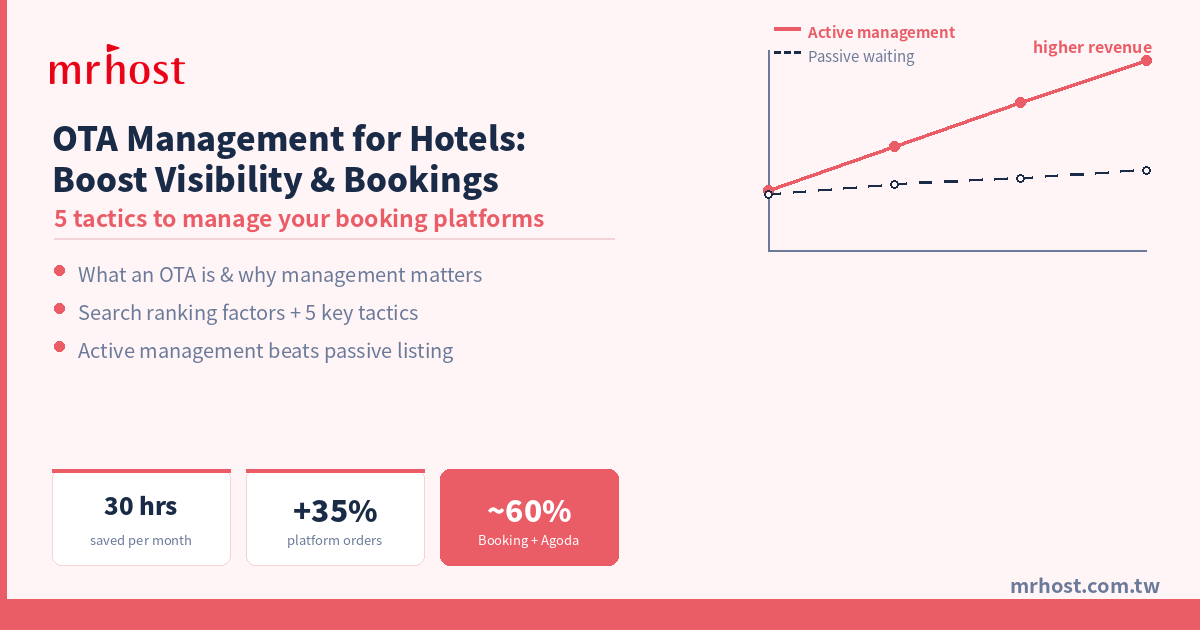
OTA search-ranking logic is complex, involving review score, conversion rate, price competitiveness, rate-plan completeness and more. At the same time, if rates aren’t kept consistent across platforms, travelers comparing prices will pick the cheapest one — costing you room revenue and rendering your carefully set promotions meaningless. For operators selling across many platforms, the day-to-day work is intricate. Active platform management keeps your net rate consistent across platforms and uses diverse booking plans to raise both visibility and order volume. On average, continuous platform optimization lifts platform order volume by about 35% a year.
Further reading: OTA Management for Hotels: What It Is + 5 Tactics to Boost Visibility and Bookings
2. Dynamic pricing system: adjust automatically to maximize revenue
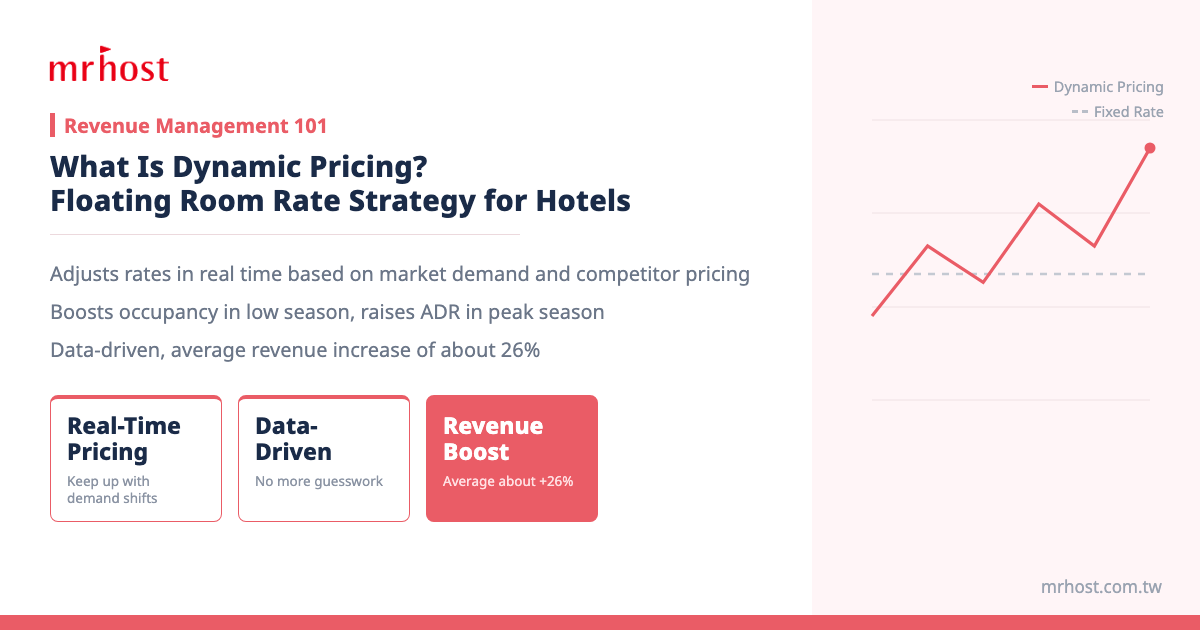
A dynamic pricing system adjusts rates automatically based on real-time demand, occupancy and competitor pricing, so you always catch the best booking opportunity. In the low season you can win bookings and lift occupancy; in peak season you can raise the average daily rate (ADR) to maximize revenue.
The value of dynamic pricing is that it solves the fixed-rate dilemma of “can’t sell in the low season, sells too cheap in peak season.” The system analyzes special events, competitor rates and your own occupancy every day, and adjusts accordingly. For properties whose room types each need different pricing, this daily workload is huge. Operators using a dynamic pricing system see revenue rise by about 26% on average, while saving 30+ hours of manual work a month.
Further reading: What Is Dynamic Pricing? The Floating-Rate Strategy Every Hotelier Should Know
3. Direct-booking growth: cut commission, raise the direct share
OTAs bring volume, but commission isn’t cheap (typically 15–18%). Lowering OTA commission by growing your direct (own-website) share and building a membership system is, over the long run, one of the most important things a property can do. With professional website pricing and plan design, you can nurture repeat guests and grow the share of direct bookings.
The benefit of direct bookings isn’t only saved commission — these are “your own guests”: you hold their contact details and can cultivate repeat stays. Every percentage point of direct share saves a meaningful sum in commission each year. On average, integrated website marketing noticeably raises the direct-booking share and cuts platform fees by about 22%.
4. Dedicated consultant: expert advice and operational analysis
A dedicated revenue management consultant provides tailored market analysis and operating strategy, helping you manage daily operations more efficiently and respond quickly to market shifts. Through regular strategy meetings and integrated cross-platform data analysis, the consultant gives stage-by-stage adjustment advice. The consultant also communicates better with each platform’s contact — whether handling complaints or clearing platform anomalies — saving on-site teams a great deal of time.
For properties with limited staff, the value is this: you don’t need to become an OTA expert or watch the market every day. You hand that to the consultant and focus on service quality and on-site operations.
3. Which properties is revenue management for?
Revenue management isn’t only for big chains. From urban business hotels and resorts to boutique properties, B&Bs and unique stays, all can benefit clearly. These types especially:
- Hotels with many room types and channels: the more room types and sales channels, the more complex pricing and inventory become, and the more a systematic strategy helps
- Hotels with strong seasonality: resort and scenic-area properties that need to win bookings in the low season and lift revenue in peak season
- Hotels over-reliant on OTAs: those wanting to cut commission and build direct-booking ability
- Properties with limited or changing staff: no dedicated pricing person, or the responsible colleague has left, needing stable external support
- Small and mid-sized hotels and B&Bs: few rooms, but each room’s pricing decision has a more direct impact on total revenue
4. How to start with revenue management
There are usually two ways:
Use tools yourself: several revenue management tools can connect to OTAs and adjust rates automatically. Suited to operators with the time and data skills who want full control.
Engage a revenue management partner: professional consultants paired with AI tools manage it for you, and you just confirm the strategy direction periodically. Suited to properties with limited staff who want to focus on service quality. mrhost provides this kind of integrated service, covering all four pillars above.
FAQ
Q: How is a revenue management service different from a booking system (PMS)?
A: A PMS mainly handles room assignment and order information; a revenue management service focuses on “how to sell each room at the most suitable price,” including dynamic pricing, platform management and data analysis. The two connect: the PMS pushes inventory, the RMS pushes price.
Q: Do small and mid-sized hotels really need revenue management?
A: Yes. They have fewer rooms, but each room’s pricing decision has a more direct impact on total revenue; with limited staff and no time to watch the market daily, they need revenue management support all the more. The same applies to B&Bs.
Q: How soon will I see results?
A: Usually noticeable changes in booking rate and revenue within 1–3 months, and more precise results after 3–6 months as the AI system accumulates more data.
Q: Are there lock-in contracts? How are fees calculated?
A: Fees and contract terms vary by provider; consult directly to find the plan that fits your scale. A free consultation can first show your property’s revenue-optimization potential before you decide.
Q: After adopting a revenue management service, do I still control my rates?
A: The service can push prices for you or give price recommendations; the final rate is yours to decide. The target occupancy and three pricing strategies (brand-first, revenue-maximizing, aggressive) stay in the owner’s hands, and the consultant can help you adjust flexibly to market conditions.
*Testimonials and data are provided by individual clients and reflect their personal views and experience. They do not represent the experience of all users, nor do they constitute a guarantee of similar results.
This article was written by the mrhost revenue management team. mrhost provides hospitality revenue management consulting, helping hotels and homestays across Taiwan and the Asia-Pacific region grow revenue and stay competitive.