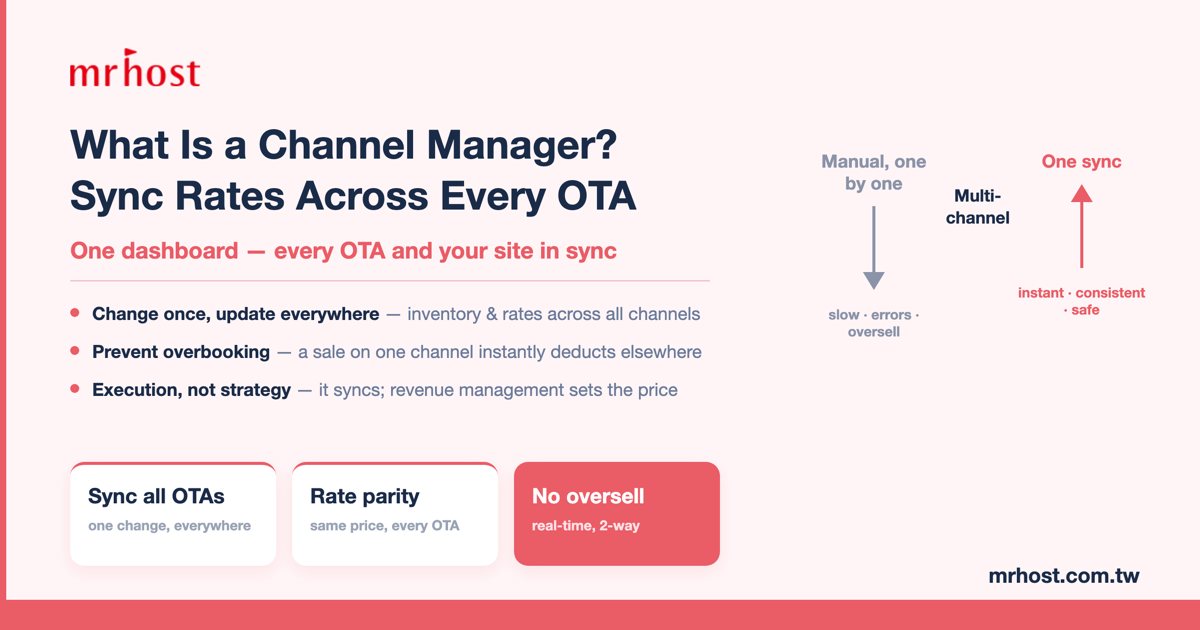
A channel manager — formally a Channel Management System (CMS) — is the system that lets a property update its room inventory and rates in one place and push them instantly to every sales channel — OTAs like Booking.com, Agoda and Expedia, plus the property's own booking engine. It solves a familiar problem for any operator selling across many platforms: updating prices and availability on each extranet by hand is slow, error-prone, and a fast track to overbooking. A channel manager turns that into "change once, update everywhere," frees your team from repetitive back-office work, and lets your revenue management strategy actually reach every channel in real time.
Key takeaways
- Change once, update everywhere. Set inventory and rates in a single dashboard; they sync instantly across all OTAs and your direct booking engine — no more manual extranet-by-extranet edits.
- It kills overbooking. When a room sells on one channel, it's immediately deducted everywhere else, sharply cutting the risk of selling the same room twice and having to cancel.
- It's the execution layer, not the strategy layer. A channel manager distributes the rates you set; what price to charge, and when to push for occupancy versus hold rate, is still revenue management's job.
- It helps your direct channel win. Bring your website's booking engine into the same sync and your direct rates stay consistent with OTAs — the foundation for pulling bookings back to higher-margin direct bookings.
- Size doesn't matter — exposure does. The fewer rooms you have, the more an oversell hurts; the more platforms you list on, the harder manual management becomes.
1. What a channel manager is — and why multi-channel distribution needs one
To get rooms in front of more travelers, hoteliers list on several OTAs and run their own website too — that's multi-channel distribution. More platforms mean more visibility, but also more complexity: every platform has its own extranet, and adjusting weekend rates or closing out a room type that's down to its last two units means logging into each one and editing by hand.
The more channels you add, the more this becomes a daily, zero-margin-for-error chore. Edit too slowly and you miss the peak-season rate; miss an update and low-season availability falls out of sync; worst of all, two platforms sell your last room at nearly the same moment — an overbooking that forces you to cancel a guest and take the review hit.
A channel manager — also called a Channel Management System (CMS); in Japanese, a site controller — exists to fix exactly this: one central hub manages inventory and rates, then syncs them to every channel in real time.
Note on roles: a channel manager is not the same as your PMS, booking engine, or RMS. The PMS (Property Management System) manages rooms and reservations, the booking engine takes direct bookings on your site, and the RMS (Revenue Management System) decides the price. The channel manager owns the layer in between — pushing inventory and rates out to every channel and pulling reservations back in.
2. How a channel manager works — four core functions
- Real-time two-way inventory sync. A sale on any channel instantly deducts that room everywhere else; opening or closing rooms in your hub pushes to every platform too. This is what prevents overbooking.
- Centralized rate control. Set a price once and it updates across all platforms — so when revenue management raises ADR for peak demand or drops rates to drive occupancy in the low season, the change reaches every channel at once, with no platform left showing last week's price.
- Rate parity. Central management keeps rates and conditions consistent across OTAs, avoiding the same room appearing at different prices because someone forgot to update one extranet.
- Unified reporting and direct-channel integration. See bookings, inventory and performance across channels in one view — and, crucially, bring your booking engine into the same sync so your website never competes with itself against the OTAs. That's the basis for shifting volume to lower-cost direct bookings.
3. Channel manager vs. revenue management: one syncs, the other decides the price
Many operators install a channel manager and discover that the sync problem is solved, but revenue doesn't automatically improve. That's because a channel manager is the execution layer — it faithfully distributes whatever rates you set, but it won't tell you what to charge this weekend or whether to chase occupancy or protect rate.
Pricing is the job of revenue management: reading the market and your competitive set, pricing by the day against supply and demand, and setting the season-long strategy. The channel manager makes that strategy land fast and accurately — but the strategy itself still has to be made.
This is also where mrhost fits: mrhost primarily provides a revenue management service — run for you by dedicated consultants backed by AI tools — helping you sell each room to the right guest, at the right time, at the right price, to maximize total revenue. We connect to the channel managers and booking systems already common in the market (SiteMinder, Owlting, Nabe, Cloudbeds, TRAIWAN and more) at zero switching cost. What we do is make the strategy land: Smart Pricing computes day-by-day, room-by-room rates from real demand; a revenue management consultant reads the market and sets strategy; and OTA Management helps you operate and optimize across those channels — so you get the most out of the channel manager you already use.
Manual multi-platform management vs. a channel manager
| Aspect | Managing each platform by hand | Using a channel manager |
|---|---|---|
| Rate changes | Log into each platform separately — slow | Set once, syncs everywhere |
| Availability updates | Easy to miss, falls out of sync | Real-time two-way sync |
| Overbooking risk | High (two platforms sell the last room) | Sharply reduced (sale deducts inventory) |
| Labor cost | High, repeated daily | Low, frees the team for strategy |
| Rate parity | Drifts when an update is missed | Kept consistent centrally |
| Direct-channel integration | Website often left out | Website syncs with OTAs, helps direct |
Who this is for
- Hotels and homestays listing on multiple OTAs with limited inventory, where an oversell hurts most.
- Operators who want to grow direct bookings and cut OTA commission.
- Teams stretched thin by daily rate and availability updates across platforms.
- Properties whose rates need frequent peak/low-season adjustment that manual syncing can't keep up with.
FAQ
Q: What exactly is a channel manager?
A: A central hub where you set inventory and rates once and sync them instantly to every sales channel (OTAs and your booking engine), with all reservations pulled back into one place. Its core value is "change once, update everywhere" — and it prevents overbooking.
Q: How is a channel manager different from a PMS or a booking engine?
A: Different roles. The PMS manages rooms and reservations, the booking engine takes direct bookings on your site, and the channel manager syncs inventory and rates out to every channel and pulls bookings back. They usually work together, and many modern systems bundle these functions.
Q: If I have a channel manager, do I still need revenue management?
A: Yes. The channel manager is the execution layer that distributes the price you set; deciding what to charge and when to chase occupancy or hold rate is revenue management's job. The tool makes strategy land fast — but the strategy still has to be made.
Q: My homestay only has a few rooms — do I really need one?
A: It applies just as much; with fewer rooms, an oversell actually hurts more — your only room sold twice and a forced cancellation hits a small property's ratings hard. If you list on two or more platforms, a channel manager saves time and cuts risk.
Q: Can a channel manager help me win back direct bookings?
A: It's an important first step. Once your booking engine is in the same sync, your website's availability stays consistent with the OTAs, so you can confidently promote direct offers and shift volume away from high-commission platforms — lowering fees and building your own guest base over time.
Q: Does mrhost sell a channel manager?
A: What mrhost mainly provides is a revenue management service — our dedicated consultants, backed by AI tools, run it for you, helping you sell each room to the right guest, at the right time, at the right price, to maximize total revenue. We connect to the systems already common in the market (SiteMinder, Owlting, Nabe, Cloudbeds, TRAIWAN and more) at zero switching cost — keep whatever you use today. Start with a free consultation to see your property's revenue upside, then decide whether to come on board.
This article was written by the mrhost revenue management team. mrhost provides revenue management consulting for accommodation providers, helping hotels and homestays across Taiwan and the Asia-Pacific region grow revenue and stay competitive.