Typhoons, earthquakes, heavy rain, and flight cancellations are among the few demand shocks a hotel cannot foresee. Unlike holidays and big events, a disaster not only strikes at short notice but hits accommodation demand in two directions — on one side, guests can’t get in and cancellations surge, pulling demand down; on the other, travelers are stranded, unable to get home or make a flight, pushing last-minute demand up — and the two can happen at once. In this situation, what a hotel should really do is not seize the moment to raise rates, but manage its inventory response: spotting and recovering the inventory released by cancellations, keeping guests with a flexible cancellation policy, and serving stranded travelers with steady, transparent supply. This guide explains the two-way impact of disasters and flight cancellations, how to respond to both cancellations and stranded demand, and the line between dynamic pricing and disaster price gouging.
Key Takeaways
- The biggest difference from an ordinary peak season is that a disaster is unpredictable, and its impact on demand is two-way — cancellations pull demand down, stranded travelers push it up, and both can happen at once.
- When demand falls, the priority is to spot “phantom vacancies,” reprice and re-sell the released inventory promptly, and keep guests with a flexible cancellation policy (rebooking over refunds).
- When demand rises, the priority is to serve stranded travelers with steady, transparent supply — not to exploit the moment with gouging.
- Dynamic pricing during a disaster (transparent, reasonable) and disaster gouging (opaque, overcharging) are two different things; the latter breaks the rules and severely damages the brand.
- A disaster can’t be predicted, but the response process can be prepared in advance — the cancellation policy and a response SOP are homework you can do beforehand.
1. Why are disasters and flight cancellations a “two-way” shock?
Holidays are predictable, and big events are broadly predictable once announced, but sudden situations like typhoons, earthquakes, heavy rain, and flight cancellations can hardly be known far in advance. This is the most fundamental difference from the two earlier kinds of demand peak — you can’t plan months ahead; you can only respond quickly as the event approaches or hits.
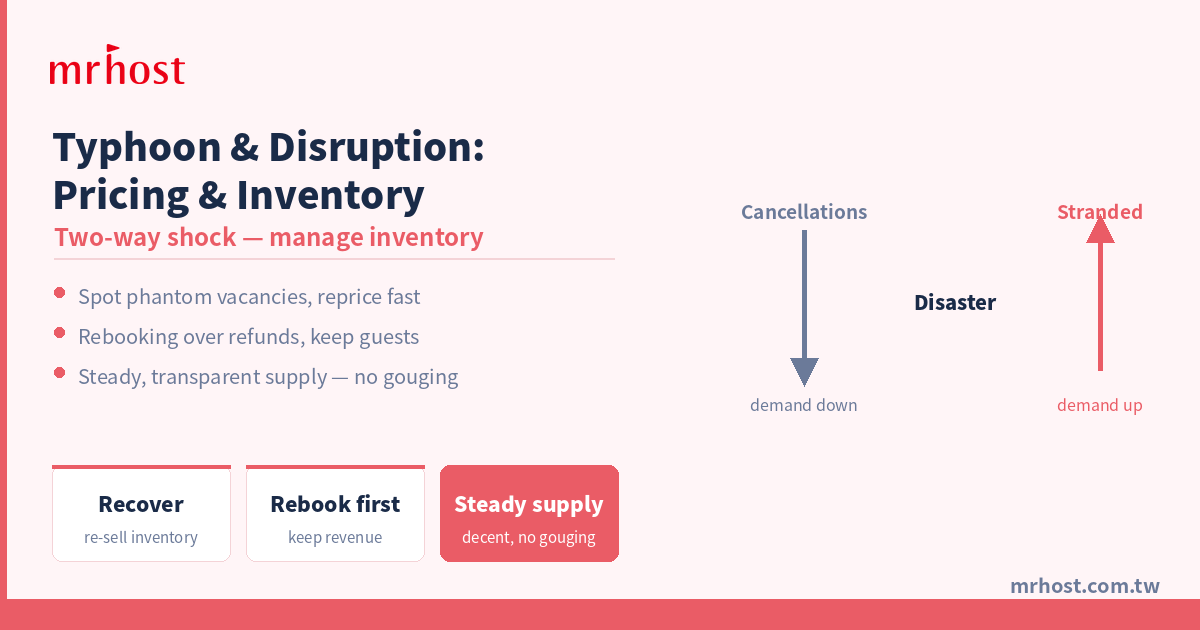
What makes it trickier is that a disaster’s impact on accommodation demand isn’t in a single direction but two-way, sometimes at the same time:
Demand down: guests can’t get in, and cancellations surge. When a typhoon hits, flights are cancelled, or transport is cut, guests who were coming may cancel at the last minute, or simply can’t arrive. Confirmed bookings get cancelled one by one, rooms appear to open up, and occupancy rate drops sharply.
Demand up: travelers are stranded, and last-minute demand rises. The same disaster can leave another group “unable to leave” — stranded around the airport when flights are grounded, stuck in a city when trains stop, or locals who can’t get home for some reason. These people need a room urgently, often for that very night.
For a hotel, this means the question during a disaster isn’t “how much should I raise rates,” but “how do I catch both of these opposite shifts at once” — re-selling the cancelled inventory promptly while steadily absorbing the stranded demand that suddenly appears. It’s a test of inventory response.
2. Demand down: the cancellation wave and inventory recovery
First, spot the “phantom vacancies”
What’s most worrying during a disaster isn’t empty rooms but “phantom vacancies” — bookings that look live but whose guests won’t actually come. When flights are cancelled or transport is cut, some guests haven’t cancelled yet; the booking still sits in the system, but they simply can’t get there. Treat these as “sold” and fail to release and re-sell them in time, and you leave the inventory sitting there while its time value drains to zero by midnight. During a disaster, confirm booking status more proactively than usual, and identify the inventory that definitely won’t be taken up as early as possible.
Reprice and re-sell the released inventory in real time
Inventory released by cancellations and phantom vacancies should be re-listed as quickly as possible at a price that reflects the current market. During a disaster, demand shifts fast and booking lead time is extremely short (a booking may come in only on the day), so which way to move rates depends on whether the moment is “mostly cancellations, soft demand” or “mostly stranded travelers, surging last-minute demand” — the former calls for winning bookings and lifting occupancy, the latter for steady supply. The point is to get the released inventory moving again, not leave it empty until midnight.
Keep guests with a flexible cancellation policy: rebooking over refunds
A disaster is when a cancellation policy is tested. Design the mix of options in advance — a refundable standard rate, and a more attractive non-refundable option — and let guests choose by their own needs. When a disaster actually happens, rather than letting guests refund outright and turn into pure lost bookings, proactively offer the flexibility to rebook: keep the business and move the stay to a later date, which both retains the revenue and makes guests remember how gracefully you handled the situation. OTA platforms usually have force-majeure handling mechanisms too; knowing these rules makes cancellations and changes smoother and reduces complaints and negative reviews.
3. Demand up: stranded travelers and last-minute demand
Stranded demand concentrates at transport hubs, with extremely short lead time
When a disaster strands people, last-minute accommodation demand concentrates around airports, train stations, and transfer hubs — and almost all of it is “needed tonight.” This kind of booking has extremely short lead time; a hotel that reacts fast enough and has a clear room picture can capture it. Hotels near transport hubs especially should watch their room situation during a disaster and keep some flexibility in sellable inventory — don’t lock every room down or clear them all out before the situation is clear.
Supply steadily and transparently, rather than exploiting the moment
This is the most sensitive point of disaster pricing. Serving stranded travelers is a service, but during a disaster guests are vulnerable with limited choices, so the price needs to hold steady and be clearly displayed. Pushing rates to absurd levels to cash in on a disaster may earn a little more in the short term, but it will be remembered by guests, amplified by public opinion, and may even be audited by the authorities — at the cost of brand damage that’s hard to undo. Decent, steady supply is in fact the moment during a disaster that builds the most trust and the best reviews.
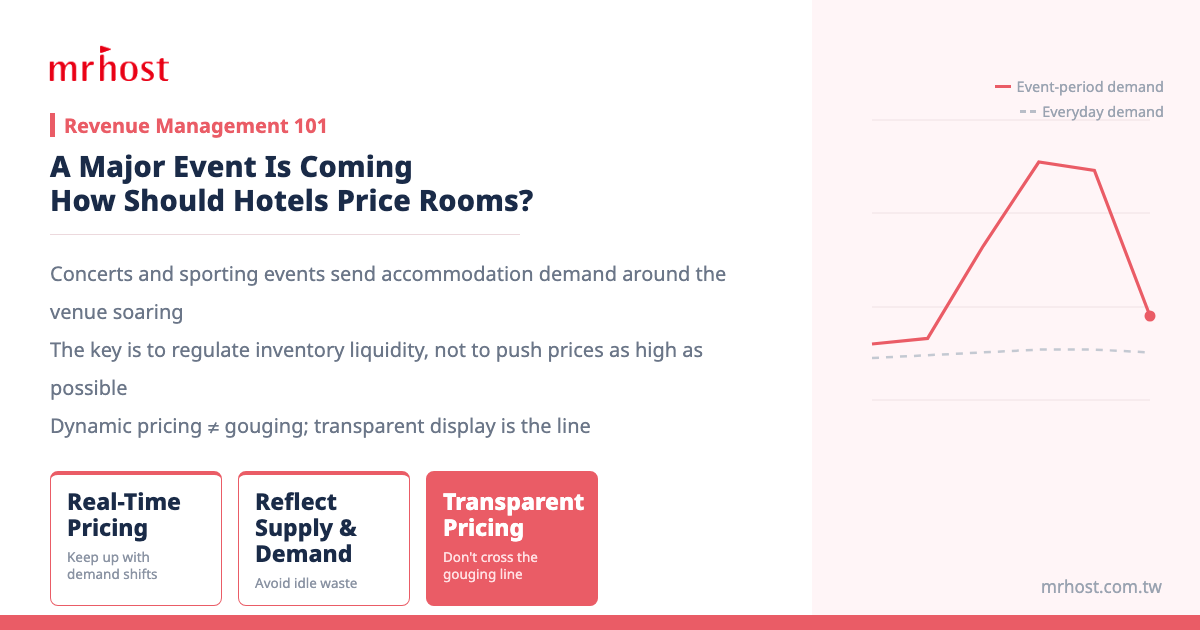
4. Drawing the line: dynamic pricing during a disaster ≠ disaster gouging
When it comes to pricing during a disaster, one line has to be drawn even more clearly than usual. Every time there’s a typhoon or major incident, the news carries stories of “operators jacking up prices during a disaster and being fined” — and that hurts how the whole industry is seen.
Be clear about this: dynamic pricing — based on market supply and demand, transparently displayed in advance, and clearly known and agreed by the guest at the moment of booking — and last-minute gouging, on-the-spot overcharging, or adding charges to an already-confirmed booking after the fact, are entirely different things. The former is a normal market mechanism; the latter may breach relevant regulations, and leaves the worst impression at the moment a guest is most helpless.
During a disaster, this line must be held more strictly than for a concert or a holiday — because the guest right now “has no choice but to stay,” rather than “coming for an event.” The same percentage increase carries completely different optics and legitimacy. Real revenue management seeks a balance between short-term revenue and long-term brand trust: absorb demand at a steady, transparent price, so that when guests look back they feel “that place was decent even on a typhoon day” — worth far more than a one-off windfall.
5. Real-time response keeps up better with tools
A disaster demands speed — cancellations must be spotted in real time, released inventory repriced in real time, stranded demand absorbed in real time, and all of this may swing back and forth within a day, even within hours. Watching booking after booking and repricing room type by room type by hand can hardly keep up with the pace of a disaster as it unfolds.
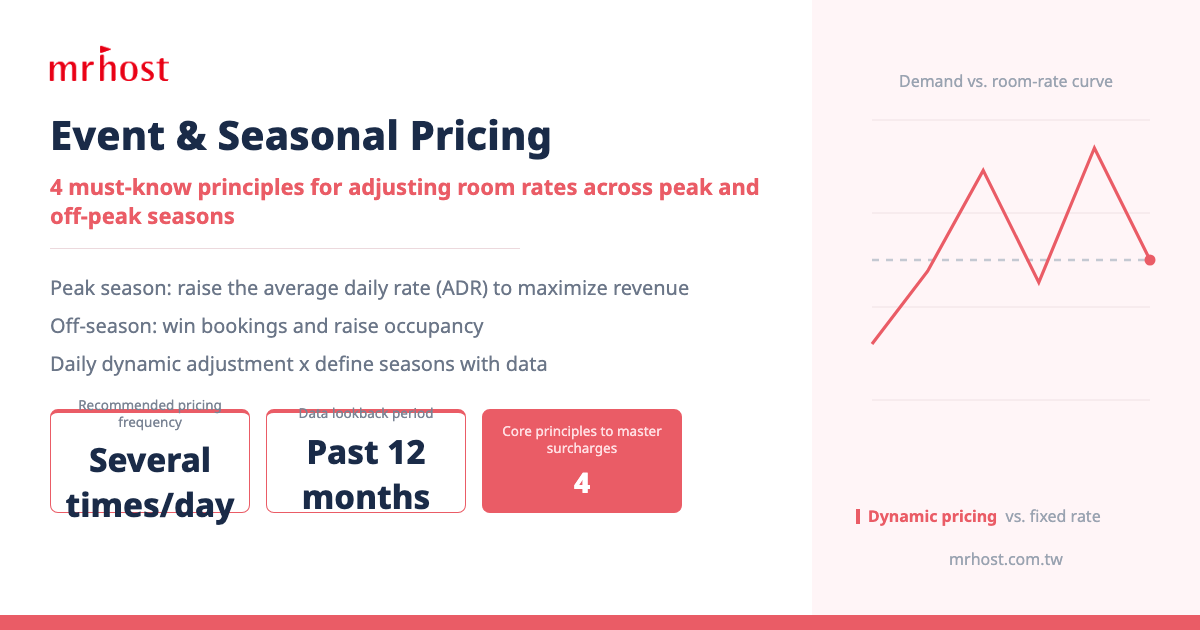
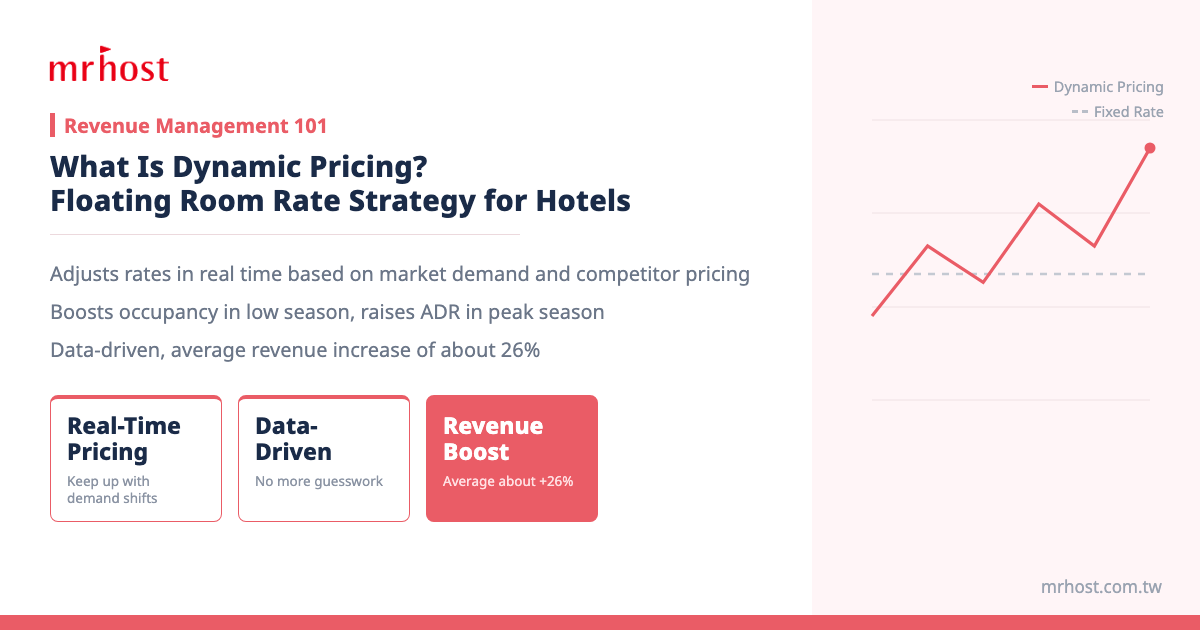
The value of a Smart Pricing (dynamic pricing) system is especially clear in this kind of fast-changing scenario: it can adjust rates automatically on real-time data, updating many times a day, quickly repricing and re-selling the inventory released by cancellations, while winning bookings when demand is soft and supplying steadily when stranded demand surges. A revenue management consultant helps read the situation, decide whether to win bookings or hold rates in the moment, and bring prices and policies back onto a normal track once the event is over — so that even at its most chaotic, a hotel can keep its inventory flowing healthily in an orderly way.
6. A disaster can’t be predicted, but the “response process” can be prepared in advance
A disaster’s defining feature is unpredictability, but that doesn’t mean you can only panic on the spot. The exact opposite of a holiday’s “predictable, plan ahead,” what a disaster lets you prepare in advance is not the price but the process:
- Cancellation policy: design the mix of refundable / non-refundable options in advance, and work out a “rebooking first” principle for when a disaster hits.
- Response roles: who confirms phantom vacancies, who re-lists inventory, who handles the OTAs’ force-majeure processes.
- Price recovery: agree at the planning stage how prices return to normal market levels after a disaster, so prices don’t get stuck high while rooms sit empty once the event passes.
Prepare these while the weather is calm, and when something really happens you can respond calmly rather than scramble.
Who this is for
- Hotels near airports, train stations, and transfer hubs, well placed to absorb stranded demand
- Hotels in areas where typhoons, heavy rain, and other disasters are more frequent
- Hotels that rely on cross-region or cross-border guests and are easily affected by transport and flights
- Hotels whose cancellation handling and policy aren’t yet systematized
- Homestays apply equally: with few rooms, one cancellation wave or one phantom vacancy has a more direct impact
FAQ
Q: How is inventory response during a disaster different from ordinary peak-season repricing?
A: The biggest difference is that it’s unpredictable and demand is two-way. An ordinary peak season sees demand clearly rise and rates go up; a disaster may bring cancellations (demand down) and stranded travelers (demand up) at the same time. The focus isn’t on raising rates but on promptly spotting and re-selling the inventory released by cancellations, keeping guests with a flexible cancellation policy, and absorbing stranded travelers with steady supply.
Q: Can I raise rates on a typhoon day? Will it count as gouging?
A: A price based on supply and demand, displayed transparently in advance, and clearly agreed by the guest at booking is normal dynamic pricing; failing to display prices honestly, overcharging on the spot, or adding charges to an already-confirmed booking after the fact is gouging, which may breach regulations and severely damage the brand. During a disaster guests have limited choices, so this line must be held more strictly than usual — prices need to be steadier and more transparent.
Q: A guest wants to cancel because of a typhoon — should I let them refund?
A: Check your rate terms first, but compared with the pure loss of an outright refund, proactively offering a rebooking is usually better — it retains the revenue and makes guests remember your decency. OTA platforms usually have force-majeure mechanisms too; knowing the rules makes changes smoother and reduces complaints.
Q: How do I re-sell rooms quickly after disaster cancellations?
A: First spot “phantom vacancies” (bookings still live but whose guests won’t actually come), and re-list the definitely-released inventory as early as possible. Booking lead time is very short during a disaster, so rates need to be adjusted to current demand in real time; this kind of rapid inventory recovery is usually left to a dynamic pricing system.
Q: A disaster can’t be predicted — what can I prepare in advance?
A: Not the price, but the process: design the cancellation policy in advance (refundable / non-refundable options, a rebooking-first principle), agree who handles cancellations and re-listing, and plan how prices return to normal after a disaster. Prepare the process first, and you won’t panic when something actually happens.
This article was written by the mrhost revenue management team. mrhost provides hospitality revenue management consulting, helping hotels and homestays across Taiwan and the Asia-Pacific region grow revenue and stay competitive.