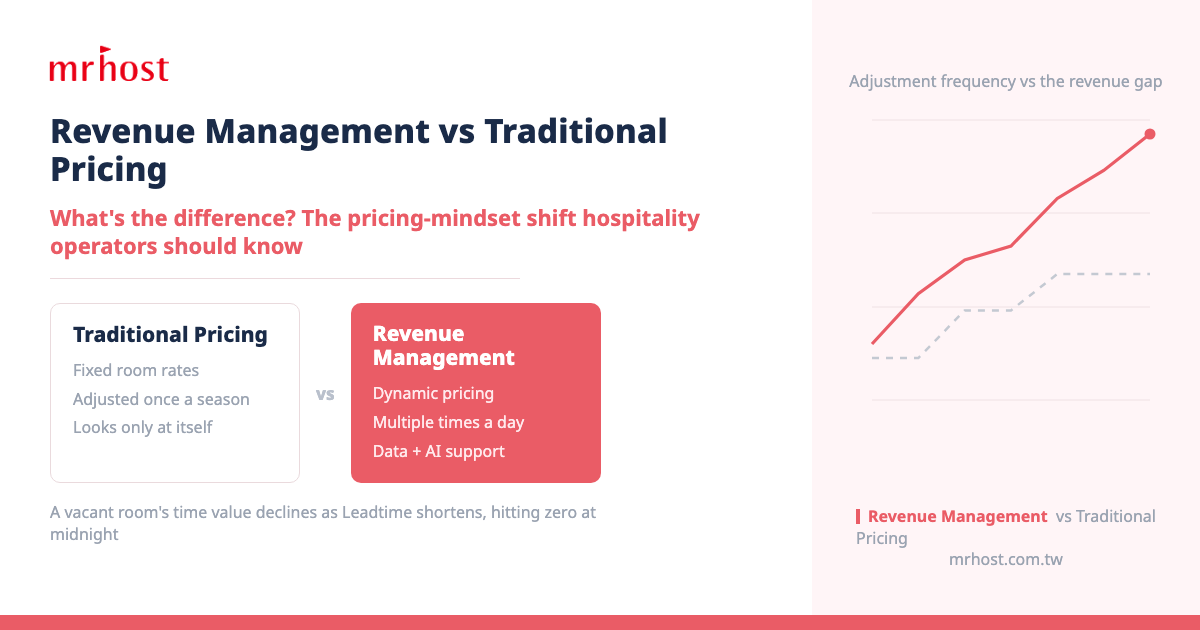
The biggest difference between Revenue Management and traditional pricing lies in whether "the price changes in real time with demand." Traditional pricing mostly uses fixed room rates with manual adjustments for peak and off-peak seasons; revenue management, by contrast, uses data analysis and dynamic pricing to adjust rates daily—or even multiple times within a single day—based on market demand, competitors' rates and your own occupancy. The goal is to sell every room at the most appropriate price before its time value drops to zero. This article compares the two pricing mindsets and explains how hospitality operators should make the shift.
1. How Traditional Pricing Works, and Its Blind Spots
Traditional pricing is the approach most properties know best: based on cost, experience and market norms, you set a relatively fixed room rate, perhaps split into weekday and weekend prices, with manual adjustments for off-peak and peak seasons.
The advantage of this approach is that it is simple and easy to manage, but its blind spots are equally obvious:
The price reacts too slowly. Market demand changes every day, but adjusting rates by hand is a heavy workload. By the time you realize that peak-season rooms are selling too cheaply, or that off-season rates are uncompetitive, the best moment to adjust the price has already passed.
It fails to account for the time value of vacant rooms. A room's time value decreases every day until, at Leadtime 0 days, it drops to zero at midnight that day. Because traditional pricing adjusts rates too infrequently or too late, operators often wait until the Leadtime is short, or until the day itself, to start adjusting prices—in effect throwing away a large portion of the room's time value.
It looks only at itself, not at the market. Traditional pricing is mostly derived from past experience and cost, with little real-time reference to competitors' rates or market dynamics, making it easy to price too high or too low without realizing it.
2. How Revenue Management Works
Revenue management is a data-driven pricing mindset whose core principle is "selling each room at the right time, to the right guest, at the right price."
It manages two things at once: price (how much each room sells for) and inventory (at what time, through which channel, and to which type of guest). In practice, revenue management continuously analyzes data such as market demand signals, competitors' real-time rates, your own occupancy and remaining room count, and the Leadtime of incoming bookings, and adjusts rates dynamically based on it—raising the average daily rate (ADR) in peak season to maximize revenue, and chasing bookings in the off-season to raise occupancy.
The key difference lies in the time granularity of price adjustments. Compared with manual adjustment, revenue management software can adjust prices multiple times within a single day, and each adjustment can update thousands of rates across all room types for the entire coming year at once. When local events, long weekends, concerts and other special occasions arise, demand can swing dramatically within a single day, and a dynamic pricing system can keep up in real time.
3. Revenue Management vs Traditional Pricing: A Comparison
| Traditional Pricing | Revenue Management | |
|---|---|---|
| Pricing basis | Cost, past experience | Real-time data such as market demand, competitors' rates and own occupancy |
| Adjustment frequency | Once or twice a season, manual | Daily, or even multiple times within a day |
| Scope of view | Mainly looks at itself | Looks at the market, competitors and its own room status simultaneously |
| Attitude toward vacant rooms | Tolerates vacancies to protect the rate | Values the time value of vacant rooms; chases bookings to fill them in the off-season |
| Off-season performance | Uncompetitive rates, many vacancies | Chases bookings to raise occupancy |
| Peak-season performance | May underestimate demand and sell too cheaply | Raises ADR to maximize revenue |
| Relies on | Human judgment | Data and AI tools as support |
4. Shifting from Traditional Pricing to Revenue Management: What Has to Change?
For hospitality operators, moving toward revenue management is not just about switching tools—it is a shift in pricing mindset:
From "holding one price" to "letting the price follow demand." You no longer cling to a single fixed rate, but accept that room rates should fluctuate with the market by nature.
From "relying on experience" to "looking at data." Experience still matters, but it must be paired with the past 12 months of booking data and competitors' real-time rates to make decisions, rather than relying on impressions alone.
From "adjusting once a season" to "monitoring continuously and adjusting in real time." This is the most demanding part of the shift—the market changes every day, and continuously monitoring and adjusting prices is a workload far beyond what most properties can handle with their own staff. This is exactly where revenue management tools and consulting services add value.
5. Moving to Revenue Management: Do It Yourself or Outsource?
Revenue management involves data analysis, market monitoring, competitor rate comparison and daily price adjustment; doing it well takes time and a certain level of expertise.
Doing it in-house suits properties that have a suitable manager, a certain level of expertise, and the time to watch the market every day. If you lack dedicated staff, or want to get up to speed faster, you can consider engaging a revenue management consulting firm, where professional consultants paired with AI tools take over the data analysis and daily price adjustment, leaving the operator to focus only on strategic direction. mrhost's revenue management consulting firm offers exactly this kind of service, helping properties transition smoothly from traditional pricing to data-driven revenue management.
FAQ
Q: What is the most crucial difference between revenue management and traditional pricing?
A: The most crucial difference is whether "the price changes in real time with demand." Traditional pricing mostly uses fixed room rates adjusted manually; revenue management adjusts rates daily, or even multiple times within a single day, through a dynamic pricing system, based on real-time market demand, competitors' rates and your own occupancy.
Q: My property is small—do I really need revenue management?
A: Yes, you do. The fewer rooms you have, the more directly each room's pricing decision affects overall revenue. Smaller hotels actually need precise pricing even more, to avoid selling too cheaply in peak season or sitting on vacancies in the off-season. The same logic applies to B&Bs.
Q: Isn't revenue management just "changing room rates all the time"?
A: A high adjustment frequency is one of its features, but the point is not "changing rates one by one by hand"—it is "adjusting in batches based on data." A dynamic pricing system can adjust thousands of rates across all room types for the entire coming year in one go, according to market conditions, and can run multiple times within a day—something humans cannot do, and that is precisely where its value lies.
Q: Why is it better to start adjusting prices as early as possible?
A: Because a room's time value decreases as the stay date approaches (as the Leadtime shortens), and drops to zero at midnight if it isn't sold that day. If you wait until close to the stay date to adjust the price, you are simply throwing away a large stretch of sellable time beforehand. Revenue management begins adjusting based on demand while the Leadtime is still long, selling as much of each day's value as possible.
Q: Does shifting to revenue management make my existing pricing experience useless?
A: No. Experience still has value; revenue management adds data and real-time market information on top of experience to make judgments more accurate. The best approach is to let experience and data validate each other, rather than choosing one over the other.
Q: I have no data analysis skills—can I still adopt revenue management?
A: Yes. Operators don't have to become data analysis experts themselves. You can use a dynamic pricing system with AI-assisted adjustments, or engage a revenue management consulting firm to hand over the data analysis and daily price adjustment to a professional team, while you focus on strategy and on-site operations.
This article was written by the mrhost revenue management team. mrhost provides hospitality revenue management consulting services, helping hotels and B&B operators in Taiwan and the Asia-Pacific region boost revenue and competitiveness.