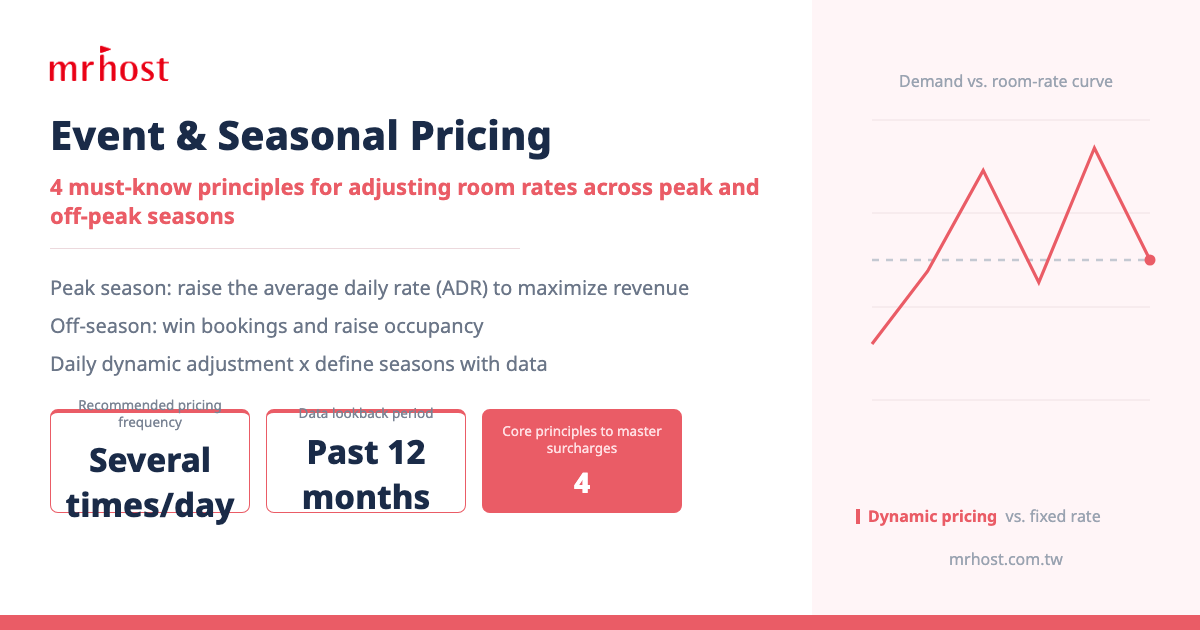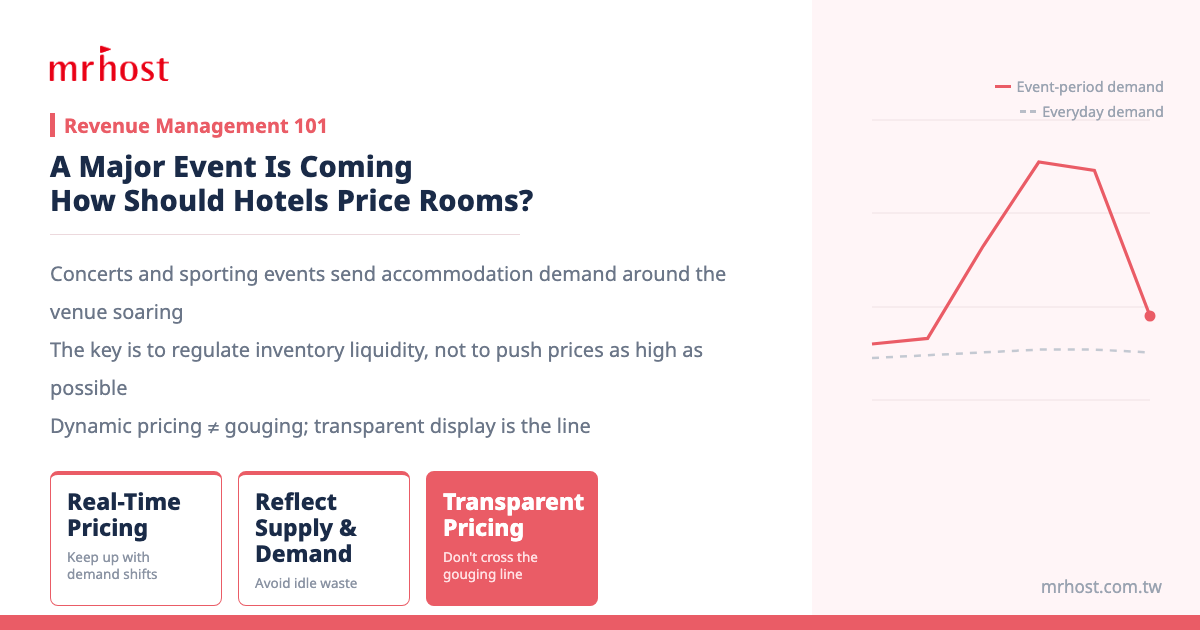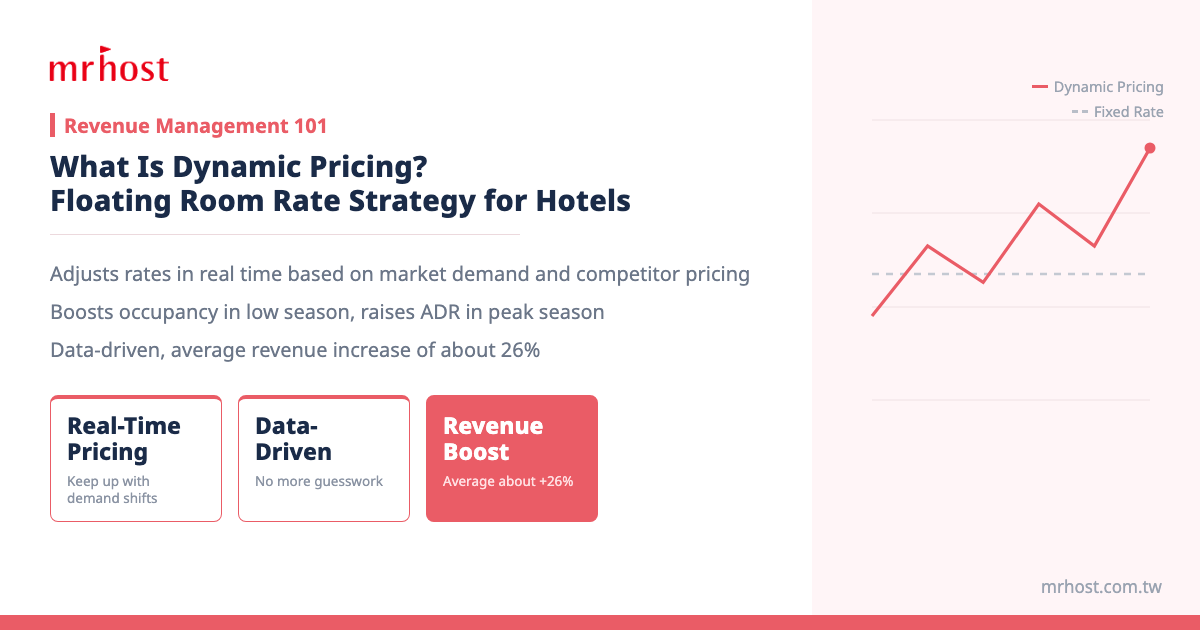
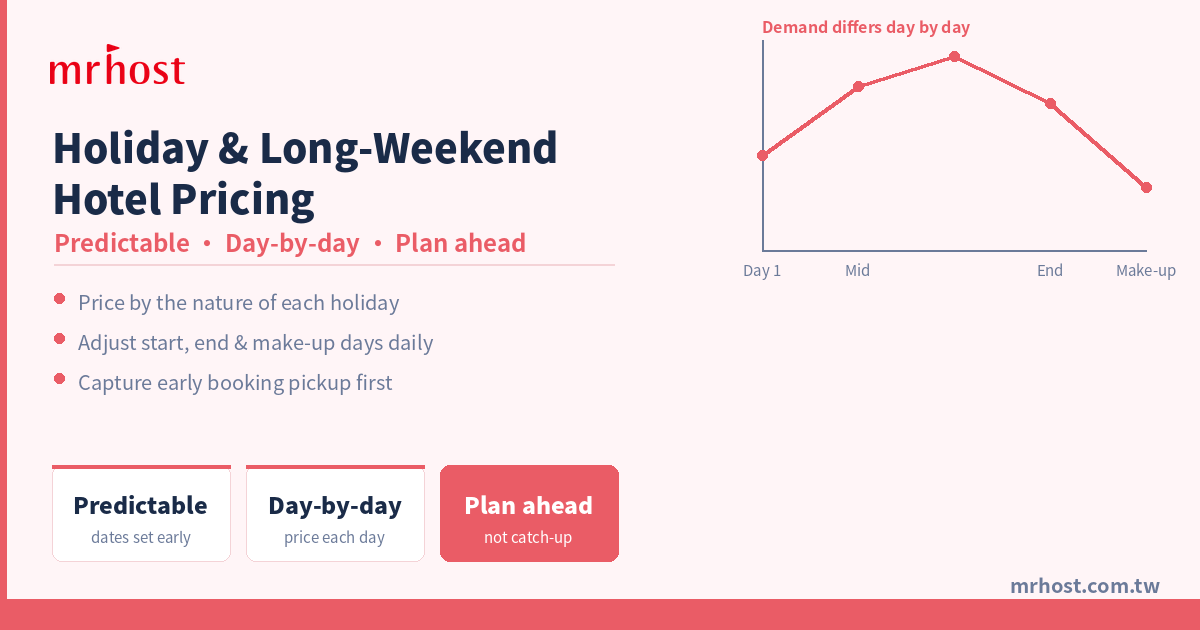
Holiday and long-weekend pricing is the revenue management practice of planning ahead and adjusting rates day by day for the predictable, government-announced public holidays and long weekends. Unlike concerts or sporting events that are announced at short notice, the defining feature of a holiday is that it is predictable — the dates are fixed more than a year in advance, giving hotels plenty of time to plan ahead. At the same time, demand within a holiday is not even from day to day: the first day, the middle, the last day, and any make-up workday each behave differently, so rates should be set day by day rather than applying a single fixed “holiday rate” across the board. Get these three things right — predictable, different each day, plan ahead — and every holiday’s demand peak can be turned into real revenue. This guide explains how holidays differ from ordinary peak seasons, the common pitfalls, how to price by the nature of each holiday, and the day-by-day mechanics.
1. How do holidays differ from an ordinary peak season — and why they deserve their own strategy
Hotels have many kinds of peak season, and public holidays and long weekends are the most distinctive of them — because they are predictable.
Predictability is a holiday’s greatest advantage
In Taiwan, the dates of public holidays and long weekends are announced by the government well in advance; the official calendar for the following year is typically published around the middle of the prior year. In other words, hotels know exactly which days will be peaks several months before demand arrives.
This is very different from event-driven demand such as concerts and sporting events. Big events are often announced at short notice, leaving hotels little time to react; holidays are the opposite — the question is never “is there time to react,” but “did you plan ahead.” Many hotels know perfectly well when a holiday falls, yet still wait until guests start enquiring and the competitive set has already adjusted rates before they begin setting prices and opening up inventory — losing the early booking pickup they could have captured first.
More holidays mean more frequent demand peaks
After the May 2025 amendment, Taiwan’s public holidays increased structurally: a “4+1” set of holidays was added (Lunar New Year’s Eve, Teachers’ Day, Retrocession Day, Constitution Day, plus making Labor Day a nationwide holiday rather than one limited to workers), bringing nationwide public holidays to 11 days and total days off to roughly 120 a year. The implication for hotels is direct: predictable demand peaks now occur more frequently than before. Without a holiday pricing strategy, you are leaving several waves of peak-season revenue on the table.
Nationwide, with longer stays
Holiday demand happens nationwide and simultaneously, unlike a big event concentrated around a venue. For the same holiday, tourist hotspots, urban business districts, and home-town areas can move in completely opposite directions. Holiday stays also tend to be longer than on ordinary days, so there is more room to lift both occupancy rate and ADR (average daily rate) — but it tests a hotel’s read of its own location.
2. The 4 most common pitfalls in holiday pricing
Before getting into the how, here are a few common traps:
Pitfall 1: Applying one “holiday rate” to every holiday. Lunar New Year, Tomb-Sweeping, Dragon Boat, and New Year’s Eve differ enormously in the nature of their demand. Forcing the same markup on all of them means giving up some revenue, or overpricing a holiday whose demand was never that strong.
Pitfall 2: Watching only the holiday itself, ignoring the start, end, and surrounding days. The first day, the middle, and the last day of a holiday don’t have the same demand, and the booking pickup (how far in advance guests book) on the days around the holiday differs too. Setting a single price is measuring four kinds of demand with one ruler.
Pitfall 3: Ignoring make-up workdays. A make-up workday looks like a weekend but is actually a working day, with demand close to an ordinary day. Pricing it like a holiday — too high — means each empty room’s value keeps draining as its lead time shortens, dropping to zero by midnight if unsold, and you also miss the chance to sell the room at the right moment.
Pitfall 4: It’s predictable, yet you open and adjust too late. A holiday is one of the few peak seasons you can plan ahead for, and the real waste is squandering that advantage — opening rates only once guests are already asking, by which point faster-moving competitors have already taken the early booking pickup.
3. Price by the nature of the holiday: different holidays, different priorities
The first step in holiday pricing is telling which kind of holiday this is. Even among three-day breaks, guests move in different directions, so what a hotel should do differs too. Below are the common holiday types in Taiwan; match them against your own location.
Homecoming / family-reunion type (Lunar New Year as the example)
During Lunar New Year, accommodation demand in urban business districts usually falls as travelers head to home towns and tourist destinations. Stays are long and the demand curve is drawn out. Hotels in tourist hotspots have more room to lift ADR; hotels in urban business districts can think in reverse — pairing long-stay packages, or targeting local and foreign guests who are “staying in the city for the holiday rather than going home,” to fill the demand that has softened.
Tomb-sweeping and short-trip type (Tomb-Sweeping Festival as the example)
Tomb-Sweeping combines homecoming/grave-visiting with short trips, so demand is more dispersed overall. Hotels near home towns, cemeteries, or nearby attractions see relatively clear demand; other locations need to rely more on real-time market data and competitive-set rates to judge strength, and should not jump straight to Lunar New Year-level rates.
Short-trip type (Dragon Boat, Mid-Autumn, Double Tenth, New Year’s Eve)
These holidays are mainly about domestic short trips; tourist hotspots across the island heat up at the same time, making this the most typical case of “raise ADR in peak season to maximize revenue.” New Year’s Eve has the added boost of countdown events — the night of New Year’s Eve is often the single strongest night of the whole break, worth lifting on its own rather than pricing the same as the other days.
| Holiday type | Representative holiday | Demand characteristics | Pricing priority |
|---|---|---|---|
| Homecoming / reunion | Lunar New Year | Urban demand falls; tourist and home-town demand rises; long stays | Location sets the direction: tourist areas raise ADR; urban hotels switch to long-stay or stay-in-the-city demand |
| Tomb-sweeping / short trip | Tomb-Sweeping Festival | Grave-visiting and short trips coexist; demand dispersed; shorter | Hotels near home towns / nearby attractions see clearer demand; other areas adjust conservatively on market data |
| Short trip | Dragon Boat, Mid-Autumn, Double Tenth, New Year’s Eve | Tourist hotspots island-wide heat up together; New Year’s Eve has countdown boost | Tourist hotspots raise ADR to maximize revenue; lift New Year’s Eve night on its own |
Actual demand varies by location and market conditions. The table is a starting point for direction, not a fixed multiplier.
4. Pricing a holiday “day by day”: start, middle, end, and make-up workdays
Once you’ve sorted out the nature of the holiday, the second step is to refine pricing granularity from “one rate for the whole holiday” down to “day by day.”
The demand curve across the start and end of a holiday
For a typical short-trip holiday, the first day, the last day, and the middle don’t necessarily have the same demand: some guests prefer to set out on the first day and return on the last, leaving the middle at the destination; others travel off-peak to avoid the crowds. What a hotel should do is read its own demand curve within the holiday from its location and the past 12 months of booking data — rather than assuming every day is equally busy.
Make-up workdays and the days around a holiday
A make-up workday has demand close to an ordinary day, so its rate should return to weekday levels rather than carrying the holiday markup. The day before and after a holiday come down to booking lead time — some guests check in the night before to set out early the next morning, so demand on these days sits between an ordinary day and the holiday, and is worth reviewing on its own.
Use minimum length of stay (min-stay) to protect revenue
If you let guests book only the middle night of a holiday, you can end up with hard-to-sell “fragmented vacancies” — the nights on either side stuck unsold. For popular holidays with clear demand, setting a sensible minimum length of stay (min-stay) keeps inventory from being cut into pieces and protects revenue across the whole holiday. This is a move that works especially well for holidays but isn’t always suitable on ordinary days.
5. Predictable doesn’t mean you don’t need tools
“Predictable” can sound like “you can just lay it out by hand,” but in practice the workload is far from small: telling apart the nature of each holiday, reading each day’s demand curve, handling make-up workdays, setting min-stays, and at the same time referencing the competitive set’s real-time rates — all multiplied across every room type, and again across the many holidays in a year.
This is exactly where a Smart Pricing (dynamic pricing) system earns its place. In one pass it can lay out thousands of rates for the whole year ahead — every room type, including every announced holiday — based on market conditions, which fits a holiday’s “predictable, plan-ahead” nature perfectly; then it makes multiple fine adjustments a day as real-time demand shifts. A revenue management consultant goes further, reading the market, setting a full pricing strategy for each holiday, and helping the operator flex among the three pricing strategies — brand-led, revenue-maximizing, and aggressive.
Planning ahead also makes a holiday a good time to grow direct bookings. Before demand pours in and guests start searching, putting an early-bird holiday offer on your own website’s booking engine lets you secure a block of direct bookings outside the OTAs — raising your direct-booking share and lowering platform commission costs.
mrhost Revenue Management pairs AI tools with dedicated consultants to help hotels turn every predictable holiday from passive catch-up into a planned-ahead revenue opportunity.
Who this is for
- Hotels in tourist hotspots where holiday demand fluctuates noticeably
- Hotels serving both urban business and holiday leisure guests, whose demand direction shifts with each holiday
- Small and mid-sized hotels with limited staff that struggle to monitor and reprice each holiday day by day
- Operators who want to plan ahead for holidays and raise their direct-booking share
- Homestays apply equally: with few rooms, mispricing a holiday or leaving fragmented vacancies costs you more directly
FAQ
Q: What is holiday and public-holiday pricing, and how is it different from ordinary peak-season repricing?
A: It’s the practice of planning ahead and adjusting rates day by day for government-announced holidays and long weekends. The biggest difference from an ordinary peak season is that it’s predictable — the dates are fixed, so hotels can plan months ahead; and because demand within a holiday is uneven day to day, you should price day by day rather than apply a single fixed holiday rate across the board.
Q: How far in advance should I start planning holiday rates?
A: As early as possible. A holiday is one of the few peak seasons you can plan ahead for. Once the government calendar is published, mark out all the holidays for the year, secure the early booking pickup before guests start searching in volume and before the competitive set has adjusted, then fine-tune later as real-time demand shifts.
Q: Can I use the same markup for every holiday?
A: Not recommended. Lunar New Year, Tomb-Sweeping, Dragon Boat, and New Year’s Eve differ greatly in demand; homecoming and short-trip types can even affect a hotel in opposite ways. The better approach is to identify the nature of the holiday first, then set pricing priorities against your own location.
Q: How should I price a make-up workday?
A: Although a make-up workday falls on a weekend, it’s actually a working day with demand close to an ordinary day, so the rate should return to weekday levels rather than carry the holiday markup — otherwise rooms sit empty and their time value drains away.
Q: Can repricing day by day and setting min-stays be done by hand?
A: It can, but the workload is heavy and hard to keep timely. Handling multiple holidays, every room type, day-by-day demand, and the competitive set’s rates all at once is usually left to a dynamic pricing system to plan ahead and fine-tune in real time, paired with a revenue management consultant to read the market — so the operator doesn’t have to watch it every day.
This article was written by the mrhost revenue management team. mrhost provides hospitality revenue management consulting, helping hotels and homestays across Taiwan and the Asia-Pacific region grow revenue and stay competitive.