Off-season demand creation is the practice of a hotel actively generating accommodation demand that wouldn’t otherwise exist — through its own events, themed packaging, local partnerships, and guest-segment work — during periods with no ready-made demand peak such as a holiday or a big event. The earlier kinds of demand peak — holidays, big events, international events — were all about “how to catch demand when it arrives”; the off-season challenge is the opposite: “how to create demand when it isn’t there.” Faced with the off-season, discounting isn’t a hotel’s only option; cutting rates blindly easily leads to a price war that sacrifices ADR (average daily rate) and the brand. Actively creating demand is what holds up occupancy rate without over-sacrificing rates. This guide explains the two off-season choices, four ways to create demand, and how to pair it with dynamic pricing to sell that demand at a healthy rate.
Key Takeaways
- In the off-season there’s no ready-made demand peak, so a hotel has two paths: passively cut rates to win bookings, or actively create demand.
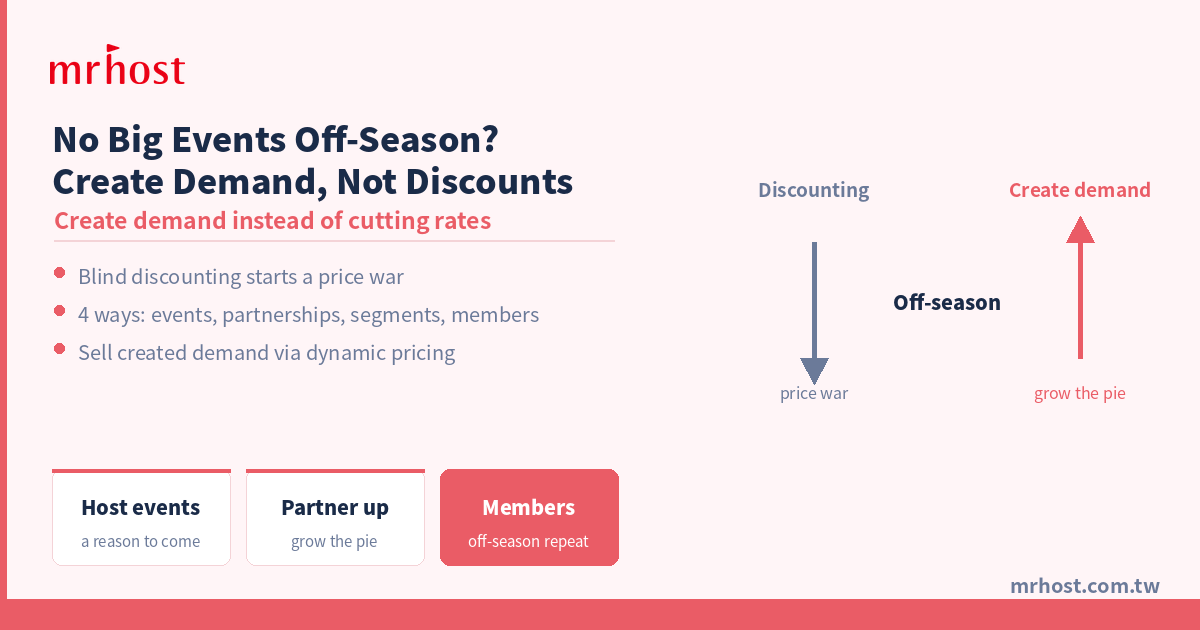
- Discounting alone easily leads to a price war that sacrifices ADR and the brand; creating demand is the lasting way out of the off-season.
- Ways to create demand: host your own events and themed experiences, offer long-stay packages, build local partnerships, target off-season-specific guest segments that don’t follow the peak-season rhythm, and grow repeat guests through your website and a membership program.
- Demand you create yourself can be sold at a healthy rate when paired with dynamic pricing, rather than at a rock-bottom price.
- The off-season is also a time to train and prepare: use it to build up your website, grow members, refine processes, and plan ahead for the next peak season and the predictable holidays.
1. Two off-season choices: cut rates to win bookings, or create demand?
The most instinctive off-season move is to discount. When demand is soft, using a more competitive price to win bookings and lift occupancy isn’t wrong in itself — it’s part of revenue management. But if discounting is the only move left in the off-season, problems begin.
When every hotel in the area is cutting prices in the off-season, the competition becomes who’s cheaper, and it’s easy to fall into a price war — you cut, the competitive set cuts, you cut again, and in the end everyone’s ADR is pushed down while occupancy doesn’t necessarily rise much. Worse, sustained low prices dilute brand value, training guests to think “this place is cheap in the off-season,” which in turn squeezes your pricing room in the peak season.
Discounting is “passively” chasing the small amount of existing demand; the real off-season solution is to “actively” create demand. The two aren’t mutually exclusive, but the mindset is completely different:
| Cut rates to win bookings | Create demand | |
|---|---|---|
| Approach | Lower rates, follow the competitive set | Host your own events, themed packaging, target new segments |
| Short-term effect | Fast — lifts occupancy a little right away | Slower — needs planning and cultivation |
| Effect on ADR | Pushes it down | Maintains, even raises it |
| Risk | Price war, brand dilution | Takes effort; not every campaign succeeds |
| Suited to | Short-term gap-filling | A lasting way out of the off-season |
Discounting can serve as a stopgap, but to really improve the off-season you have to put your energy into creating demand. Here are four directions a hotel can work on.
2. Four ways to actively create demand
Method 1: Host your own events and themed experiences — give guests a reason they “have to come in the off-season”
Guests don’t come in the off-season often because “there’s no compelling reason to come right now.” So have the hotel create one. Hosting or curating events — a themed stay night, a local cultural experience, a season-limited menu, a workshop, a small performance — lets you make your own draw during a period with no external events. The point is to upgrade “a night’s stay” into “coming for a particular experience,” so the guest’s decision is no longer only about rate.
Method 2: Local partnerships — make the pie bigger
You don’t have to create off-season demand alone. Partnering with local restaurants, experience operators, transport, or attractions to launch bundled stay packages lets you draw on each other’s guest bases and amplify the appeal. Tying the hotel to “a particular unique local experience” means the guest is buying a complete itinerary, not just a room — which also makes your package harder for the competitive set to undercut directly on price.
Method 3: Target “off-season-specific guest segments” — sidestep the peak-season rhythm
Peak-season guests (families, holiday leisure) stay home in the off-season, but some segments’ demand doesn’t follow the ordinary peak season. Business travel, long stays and remote work (workation), weekday trips by senior travelers, pet-friendly guests, special-interest groups, and even international inbound travelers on an opposite seasonal cycle, as well as long-stay needs such as medical visits, medical aesthetics, and visiting family during school holidays — these segments are exactly what can fill the off-season gap. Adjusting room types, packages, and marketing messages for them opens a new source of demand for the off-season.
Method 4: Grow repeat guests through your website and membership
Peak season runs on traffic; the off-season runs on returning guests. The off-season is the time to grow direct bookings and a membership program — turn guests who’ve stayed into members, and reach them proactively in the off-season with member-only offers and news of new experiences to drive repeat stays. Closing the sale directly through your website’s booking engine also raises your direct-booking share outside the OTAs and lowers platform commission costs. Membership and website cultivation are long-term assets; the earlier you build them up in the off-season, the higher your starting point in every off-season that follows.
3. Creating demand ≠ blind discounting: pair it with dynamic pricing to sell at a healthy rate
Creating demand and holding up your rate can be done at the same time. When a hotel brings demand up through events, themes, or segments, that demand shouldn’t be sold off at an “off-season rock-bottom rate” — it should be priced dynamically to the actual strength of demand at the time. A dynamic pricing system reflects this self-created demand in real time, fine-tuning many times a day so the rate follows the heat rather than being stuck at a low point.
One of mrhost’s partner cases illustrates this. A 10-room boutique hotel in Yuzawa, Niigata, Japan hit a sparse booking window at the end of the ski season — the third week of March 2026, typically a quiet gap. Rather than cutting prices all the way down, the owner proactively hosted several events to bring people in, while using the Smart Pricing system to adjust rates dynamically to demand. As a result, rooms that week were close to sold out, and the average rate, far from being slashed for the off-season, actually rose above its usual level.
The point of this case isn’t a particular number but the mindset: a good off-season result comes from the operator actively creating demand and then using the system to sell that demand at the right price — the two working in parallel — not from cutting rates to the bone. (Case results vary by location, market, and operating conditions, and are not a guarantee that applies uniformly.)
4. The off-season is also a time to train and prepare
Finally, look at the off-season from another angle: it’s not just a gap to be filled but a rare window to prepare. The things there’s no time for when you’re busy taking bookings in peak season are exactly what to save for the off-season: optimize your website and booking engine, build up your membership program, refine your service processes and SOPs, and analyze the past 12 months of data to find your own demand curve.
This echoes the logic that “predictable holidays should be planned for in advance” — the off-season is precisely the time to prepare for the next peak season and the holidays. Use the off-season to lay the groundwork, and when demand really returns, the hotel catches it faster and better. Creating demand and planning ahead are two things worth doing in the off-season at the same time.
Who this is for
- Hotels with a marked gap between peak and off-season, whose off-season occupancy rate clearly drops
- Hotels that have long relied on discounting to win bookings, with ADR pushed down, and want to break out of the price war
- Hotels with local character, well suited to developing themed experiences or local partnerships
- Hotels that want to use the off-season to grow direct bookings and members and build long-term assets
- Homestays apply equally: with few rooms, one or two successful themed events or partnership packages can clearly improve the off-season
FAQ
Q: What is off-season demand creation, and how is it different from off-season discounting?
A: Off-season demand creation means actively generating accommodation demand that wouldn’t otherwise exist — through your own events, themed packaging, local partnerships, and guest-segment work — during periods with no holiday or big event. Discounting passively chases the small amount of existing demand and easily leads to a price war; creating demand makes the pie bigger and holds up occupancy rate without over-sacrificing rates.
Q: Can I really not discount at all in the off-season?
A: You can — discounting works as a short-term stopgap. But if it’s the only move left in the off-season, it pushes ADR down and dilutes the brand over the long run. The better approach is to use discounting as a gap-filling tool while putting your main energy into creating demand.
Q: Resources are limited for a small hotel or homestay — can they still create demand?
A: Yes, and the payoff is more direct. With few rooms, one or two successful themed events or local partnerships are enough to clearly improve off-season occupancy. It’s not about the size of the budget but about finding your own local character and the right off-season segments.
Q: Once I’ve brought demand up myself, how should I price?
A: Don’t sell it at an off-season rock-bottom rate. When demand is up, adjust rates dynamically to the actual strength at the time — usually left to a dynamic pricing system to fine-tune in real time, so the rate follows the heat rather than being stuck low.
Q: Besides creating demand, what else can I do in the off-season?
A: The off-season is a rare window to prepare. Use it to optimize your website and booking engine, build a membership program, refine your service processes, and analyze the past 12 months of data, to prepare ahead for the next peak season and the predictable holidays.
This article was written by the mrhost revenue management team. mrhost provides hospitality revenue management consulting, helping hotels and homestays across Taiwan and the Asia-Pacific region grow revenue and stay competitive.