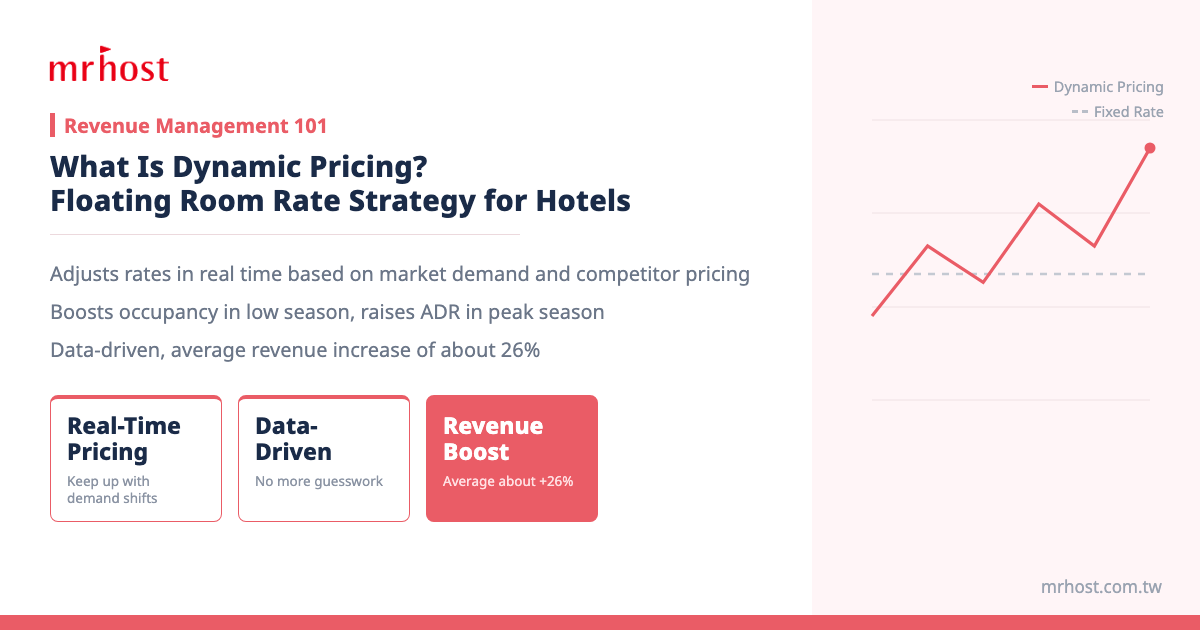
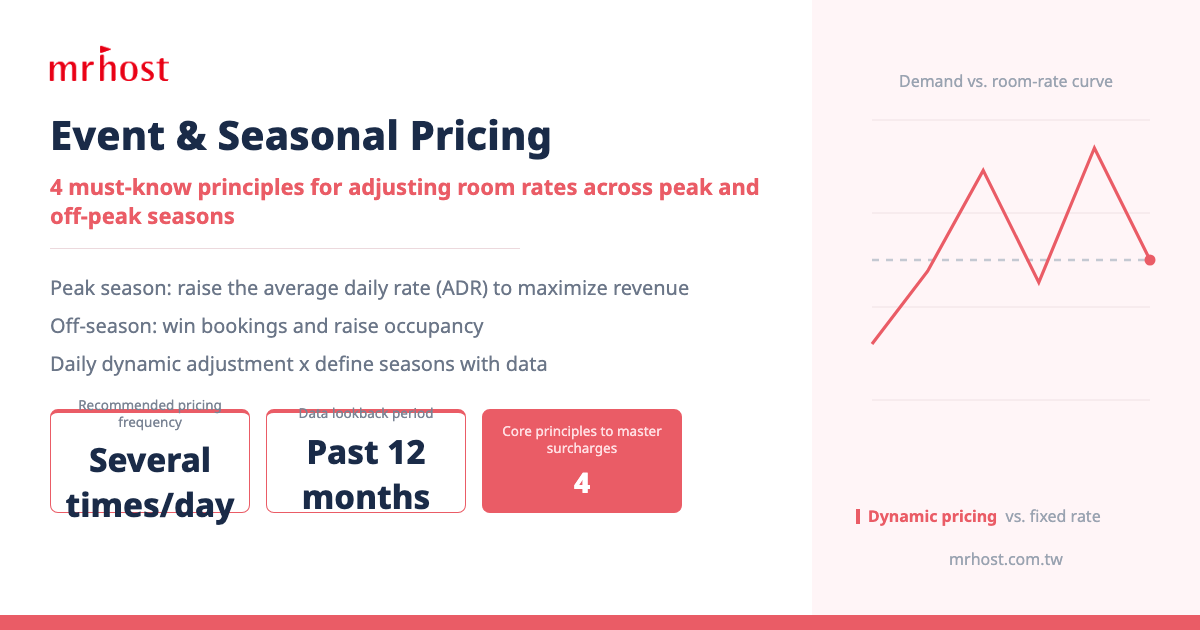
"Event-based pricing" refers to the strategy of adjusting room rates according to peak and off-peak seasons, local events, and holidays in the surrounding area to maximize overall revenue. The core of "event-based pricing" is to raise the average daily rate (ADR) to maximize revenue when demand is strong in peak season, and to win bookings with more competitive rates to raise occupancy when demand is weak in off-peak season. This article explains common pitfalls and four practical principles for mastering surcharge multipliers.
1. Why adjust room rates between peak and off-peak seasons?
The hospitality market is clearly seasonal. During long weekends, winter and summer breaks, local events, and special occasions, accommodation demand can fluctuate dramatically within a single day, and room rates should move accordingly.
If room rates are not adjusted to demand during special events, then when online booking demand surges and rates are set too low, room inventory will sell out quickly, losing the chance to raise prices; when demand drops, if rates are kept too high, the time value of every empty room keeps draining away until it reaches zero by the end of the day.
What "event-based pricing" sets out to solve is exactly this dilemma of "selling too cheap or not selling at all"——letting room rates follow demand, raising revenue when demand is high and raising occupancy when demand is low.
2. Common pitfalls of "event-based pricing"
Before discussing how to do it, let's look at a few common traps:
Pitfall 1: Raising peak-season prices so high no one books.You can raise prices in peak season, but the increase must match travelers' acceptance and competitors' prices. Overshoot, and travelers turn to other properties, which actually lowers occupancy.
Pitfall 2: Slashing off-season prices until you bleed.Cutting prices to win bookings in off-season is fine, but if you drop below variable cost, you lose money on every room sold.
Pitfall 3: Prices that are too rigid.Splitting the calendar into two blocks of off-peak and peak days, each with a single price, is too rigid. Actual demand fluctuates within a single day——during a long weekend, demand on the first day differs from the last; a typhoon or a halted train service may keep travelers from arriving while also increasing the number of travelers who stay over unexpectedly.
Pitfall 4: Looking only at yourself, not the market.Pricing based solely on past experience, without referencing competitors' real-time rates and market dynamics, makes it all too easy to price too high or too low without realizing it.
3. Four principles for mastering "event-based pricing"
1. Define your peak and off-peak seasons with data, not impressions
First review the property's booking data from the past 12 months to identify demand peaks and troughs——which months, which events, and which holidays have a longer booking lead time. A full year of data covers the complete peak and off-peak cycle, making it far more accurate than judging by impression.
2. In peak season, let "demand and competition" decide the increase
The size of a peak-season price increase is not decided off the top of your head, but by looking at two things at once: the strength of traveler demand (remaining room inventory, booking pace) and competitors' real-time rates. The stronger the demand and the higher competitors' rates, the more room there is to raise prices; otherwise, stay conservative. The goal is to land room rate and occupancy at the optimal sweet spot.
3. In off-season, use price and package combinations to win bookings and raise occupancy
The focus in off-season is winning bookings and raising occupancy, but the method is not only cutting prices. You can pair different packages——long-stay plans, unassigned room types, room upgrades, official-website specials (combined with experience itineraries)——to attract different types of guests, winning bookings without dropping rates so low that it hurts brand perception.
4. Adjust dynamically day by day, not once a week
Refine the pricing frequency from once a season or once a week down to "several times a day." Adjust room rates in real time based on each day's "occupancy," "secure-booking achievement rate," "competitors' rates," and that day's "special events." This level of granularity is hard to handle manually every day, which is exactly where dynamic pricing systems and revenue management services add value.
4. "Event-based pricing": by hand or by tool?
"Event-based pricing" sounds like "raise in peak, lower in off-peak," but doing it day by day, room type by room type, while referencing the market and competitors at the same time, is an enormous workload.
Adjusting prices manually requires watching market conditions every day. If you want to improve the effectiveness of price adjustments while reducing workload, that is when tools come in. A dynamic pricing system learns through AI and can adjust automatically based on real-time data, while a revenue management consultant can go further to interpret the market and formulate a full-season pricing strategy. mrhost Revenue Management Consulting combines AI tools with dedicated consultants to help properties get their peak and off-peak pricing adjustments right.
FAQ
Q: What is "event-based pricing"? How is it different from ordinary price adjustment?
A: Event-based pricing means raising room rates according to demand strength when facing events that drive up accommodation demand, such as local events, long weekends, concerts, and sports matches. The biggest difference from ordinary peak/off-peak adjustment is that event demand can fluctuate dramatically within a single day, so price adjustment must be more immediate and frequent rather than a single seasonal change.
Q: How do I know how much I can mark up rates during a special event?
A: Refer to two bases: your own demand strength (remaining room inventory, booking pace, booking lead time) and competitors' real-time rates. The stronger the demand and the higher competitors' rates, the greater the markup room; but still watch travelers' acceptance to avoid overshooting and losing travelers.
Q: Will cutting prices to win bookings in off-season hurt the brand or lose money?
A: Both risks need attention. Price cuts must not fall below variable cost, or you lose money on every room sold; nor should you rely on continuous discounting, which easily trains travelers to expect "wait for a discount before booking." A better approach is to pair package combinations——long-stay plans, unassigned room types, room upgrades, official-website specials, and so on——to win bookings through combinations rather than pure price cuts.
Q: During a special event, do room rates need to be adjusted several times a day?
A: Ideally, yes. Event demand changes fast, and occupancy, secure-booking achievement rate, and competitors' rates may all shift within a single day, so room rates should ideally adjust in real time. This kind of high-frequency adjustment is hard to sustain manually and is usually handed to a dynamic pricing system.
Q: Do I have to watch over all this price-adjustment work myself every day?
A: Not necessarily. A dynamic pricing system learns through AI and can adjust room rates automatically based on real-time data; paired with a revenue management consultant who interprets the market and formulates strategy, operators do not have to keep a close eye on the market and competitors themselves every day.
This article was written by the mrhost Revenue Management team. mrhost provides hospitality revenue management consulting services, helping hotels and B&B operators in Taiwan and the Asia-Pacific region boost revenue and competitiveness.