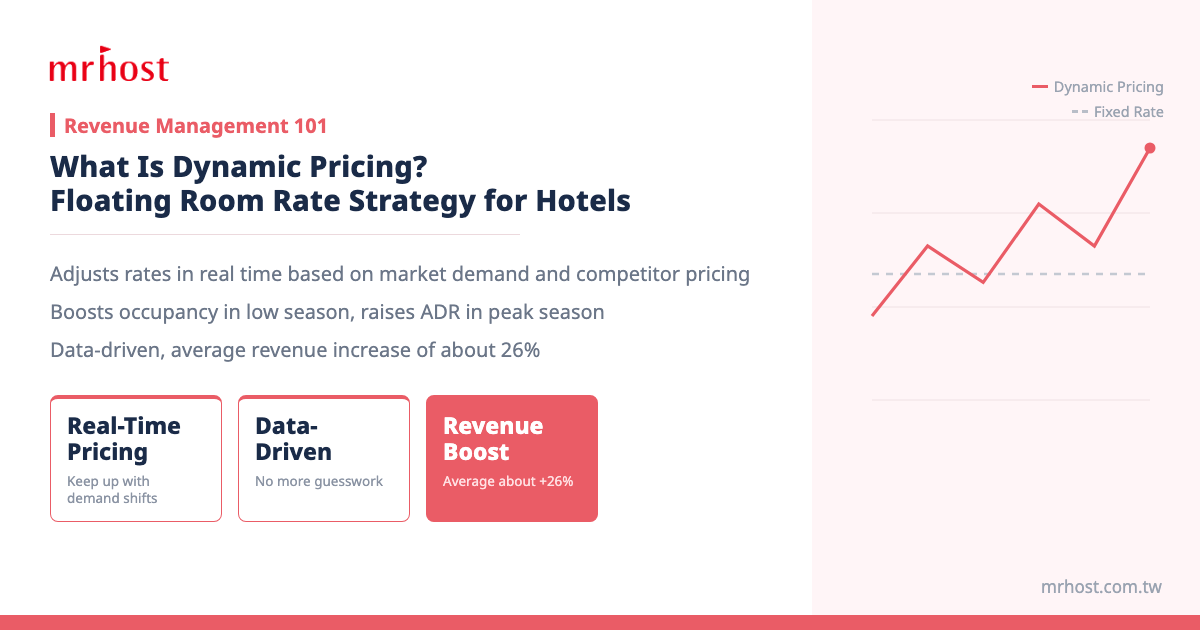
Dynamic Pricing refers to a pricing strategy that adjusts room rates in real time—either automatically or manually—based on factors such as market demand, competitor pricing, remaining inventory, and the time value of rooms. Unlike traditional fixed pricing, dynamic pricing allows accommodation operators to raise rates during peak demand and win bookings with more competitive prices during the off-season, thereby maximizing revenue per room and reducing idle, unsold rooms.
1. What Is Dynamic Pricing?
Dynamic Pricing, also known as "floating pricing" or "flexible pricing," is one of the most central strategies within a revenue management system (commonly called an RMS, Revenue Management System). Simply put, room rates are not fixed but are adjusted dynamically based on a variety of real-time factors.
You have probably already experienced dynamic pricing in everyday life—airfares change depending on when you book, Uber adds surcharges during peak hours, and e-commerce promotional prices differ from day to day. These are all applications of dynamic pricing.
For accommodation operators, the goal of dynamic pricing is clear: charge the right price to the right traveler at the right time.
2. How Dynamic Pricing Works
A dynamic pricing system continuously analyzes the following categories of data and recommends or automatically adjusts room rates accordingly:
- Market demand signals
- Local events, holidays, and long-weekend periods
- Real-time changes in booking-site or flight-search volume
- Historical booking data (year-over-year comparisons)
- Competitor pricing
- Real-time room rates of similar properties in the same area
- Competitors' promotional offers on OTA platforms
- Your own room status
- Number of remaining vacant rooms
- Number of days until the check-in date
- Current occupancy rate
- Traveler behavior data
- Average booking lead time
- Common length of stay and traveler origin
3. Dynamic Pricing vs. Fixed Pricing: What's the Difference?
| Fixed Pricing | Dynamic Pricing | |
|---|---|---|
| Frequency of price adjustment | Manual, weekly or monthly | Automatic adjustment daily or even hourly |
| Off-season performance | Frequent wasted vacancies | Proactively lowers prices to win bookings and boost occupancy |
| Peak-season performance | May underestimate demand and miss revenue | Automatically raises rates to maximize revenue per room |
| Competitive response | Slow to react | Tracks competitors and adjusts in real time |
| Management cost | Low, but poor revenue | Requires tools, but revenue improves significantly |
According to data compiled by mrhost revenue management consultancy, accommodation operators that adopt dynamic pricing see an average revenue increase of 26%, while saving roughly 30 hours of manual operation time each month.
4. Which Properties Are Suited to Dynamic Pricing?
Dynamic pricing is not exclusive to large hotels. The following types of accommodations can all benefit from it:
Boutique hotels and B&Bs: Large gaps between low and peak seasons mean flexible pricing can effectively fill off-season vacancies
Urban business hotels: Big demand differences between weekdays and weekends, where dynamic pricing can balance revenue
Scenic-area accommodations: Strongly affected by festivals and long weekends, requiring advance forecasting and price adjustments
Multi-room-type properties: Different room types have different demand curves, and adjusting each one dynamically works better
5. How to Start Implementing Dynamic Pricing?
For many accommodation operators, building a dynamic pricing system from scratch has a high barrier to entry, requiring data analysis capabilities and market monitoring tools. There are two common approaches to implementation:
Using RMS tools yourself
There are various revenue management software options on the market that can connect with OTA platforms such as Booking.com and Agoda to adjust room rates automatically. This suits operators with a certain level of technical ability or time.
Hiring a revenue management consultancy
Professional consultants paired with AI tools manage pricing on your behalf, and operators only need to confirm the strategic direction periodically. This suits properties with limited manpower that want to focus their energy on service quality.
Frequently Asked Questions (FAQ)
Q: Does dynamic pricing make travelers feel it's unfair?
A: Dynamic pricing is already the industry norm in travel, and travelers generally accept that airfare and hotel prices change over time. As long as rates remain reasonable during peak demand, the off-season gives travelers the feeling of getting a good deal.
Q: Is dynamic pricing suitable for a small B&B with only a few rooms?
A: Yes. The fewer the rooms, the greater the impact of each room's pricing decision, which actually makes precise pricing even more important. Small B&Bs often cannot monitor the market daily due to limited manpower, and revenue management services can be a great help to B&B owners.
Q: What conditions are needed to implement dynamic pricing?
A: The basic requirement is being listed on OTA platforms (such as Booking.com and Agoda) or using an official booking website. Most revenue management tools support the major OTAs.
Q: How is dynamic pricing different from promotional offers?
A: Promotional offers proactively lower prices to attract a specific customer segment, but cannot confirm whether the current rate matches market demand; dynamic pricing adjusts dynamically based on competitors' rates and market demand, aligning with the situation travelers face when choosing a hotel.
Q: After adopting dynamic pricing, how soon can results be seen?
A: Typically, noticeable changes in occupancy and revenue can be seen within 1–3 months of implementation, and after 3–6 months the strategy becomes more precise as the AI system accumulates more property data.
This article was written by the mrhost revenue management team. mrhost provides accommodation revenue management consulting services, helping hotel and B&B operators in Taiwan and the Asia-Pacific region increase revenue and competitiveness.