An OTA (Online Travel Agency) refers to online booking platforms such as Booking.com, Agoda, Expedia and Hotels.com. By listing on these platforms, hotels and lodging operators let travelers worldwide search for and book their rooms. OTA management is the systematic optimization of a property’s pricing, room-type setup, photos, reviews and promotions on these platforms, in order to improve visibility, click-through rate and final booking conversion.
1. What is an OTA?
OTA stands for Online Travel Agency — one of the most important channels for reaching travelers worldwide.
Common OTA platforms include:
- Booking.com: the world’s largest accommodation booking platform, especially strong in Europe and Asia
- Agoda: popular across Asia-Pacific, with high penetration in Taiwan, Japan and Southeast Asia
- Expedia / Hotels.com: mainly used by travelers in Europe and the Americas
- Trip.com (Ctrip): the top choice for travelers from China
- Airbnb: focused on B&Bs and unique stays
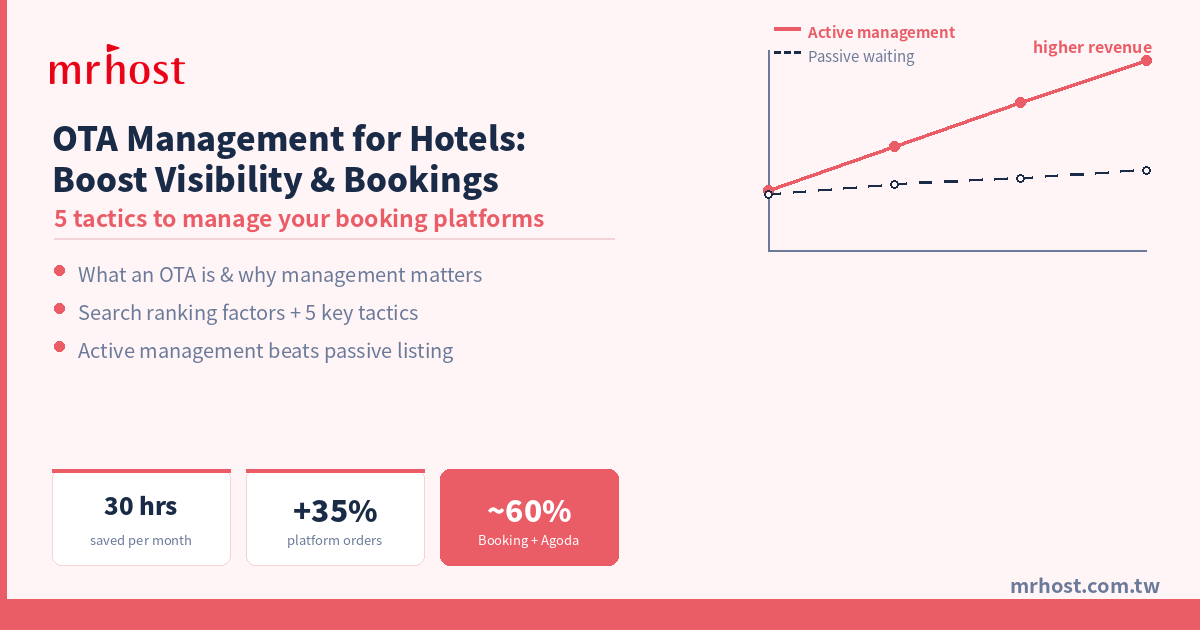
For most lodging operators in Taiwan and the wider Asia-Pacific region, Booking.com and Agoda are the two most important platforms, accounting for roughly 60% of OTA orders.
2. Why OTA management matters for hotels
Many operators treat an OTA listing as a “set it and forget it” tool once they go live. In reality, OTA algorithms and search-ranking logic are highly complex — and the revenue gap between active management and passive waiting can reach 2–3×.
OTA management has three core goals:
- Improve search ranking — the higher your property appears in a traveler’s search results, the more likely it is to be clicked
- Increase click-to-book conversion — once travelers land on your page, they’re motivated to learn more and book
- Maximize revenue per room — sell at strong rates in peak season, and avoid empty rooms in the low season
3. OTA search ranking factors
Using Booking.com as an example, the main factors that influence search ranking include:
1. Review score and number of reviews
Higher scores and more reviews push you up the rankings. This is the hardest factor to change quickly, but it has the biggest impact.
2. Booking conversion rate
The share of clicks that turn into completed bookings. A high conversion rate signals that your page design and pricing appeal to travelers.
3. Price competitiveness
Booking.com continuously monitors your pricing on other platforms; if you’re cheaper elsewhere, it can hurt your ranking (which is exactly why rate parity matters).
4. Rate-plan completeness
Whether you’ve set up early-bird discounts, multi-night deals, non-refundable rates and other options. The richer the options, the better your ranking tends to be.
5. Listing completeness
The number and quality of photos, how complete your facility descriptions are, and how detailed your room-type information is.
4. Five key OTA management tactics
1. Update rates and restrictions regularly
Don’t leave your OTA rates frozen for long periods. Based on market demand, competitor movements and remaining inventory, adjust your rates regularly (ideally daily) in line with comparable competitors and your own occupancy.
2. Set up diverse rate plans
At a minimum, offer:
- Standard refundable rate
- Non-refundable discounted rate (usually ~10% lower)
- Early-bird / last-minute deals
- Long-stay discounts (e.g., 7+ nights)
- Mobile discounts (around 89% of travelers book on mobile)
3. Manage reviews
Actively respond to every review, especially negative ones. Studies show that properties which respond thoughtfully to negative reviews earn greater traveler trust. Aim to keep your Booking.com score at 8.0 or above — the higher the better.
4. Maintain rate parity
Keep net rates consistent across OTAs to avoid losing revenue when travelers compare prices across platforms, and to trigger the platforms’ commission-cut mechanisms — getting the platform to share margin and help market your property, maximizing your revenue.
5. Analyze your data
At least once a month, review: the share of orders from each platform; occupancy by room type; whether your bookings over the past 30 days are safely on target; and whether your inventory for the next 3 months is reasonable. This data is the basis for adjusting rates and occupancy targets.
5. OTA management: in-house vs. outsourcing
| In-house | Revenue management partner | |
|---|---|---|
| Cost | Tool fees only | Consulting service fee |
| Time | ~30 hours/month | ~1 hour/month, working with a consultant |
| Skills needed | Data analysis, market research | Learn as you go |
| Results | Depends on time invested | AI-assisted, fast and effective |
| Best for | Properties with a stable manager | Properties with staff turnover or cost-optimization goals |
According to mrhost’s data, operators who use a revenue management service save an average of 30 hours per month on platform management, and increase platform order volume by an average of 35%.
FAQ
Q: Do more OTA platforms always mean more bookings?
A: Not necessarily. The more platforms you list on, the harder management becomes; if pricing and promotions aren’t well controlled across platforms, you can actually lose revenue and trigger more customer complaints. Using more platforms requires more time and resources to manage.
Q: Booking.com’s commission is high — is it still worth it?
A: Booking.com commissions are typically 15–18%. But the exposure and traveler trust it provides are hard to replace. A more practical approach: keep using OTAs to acquire guests while gradually growing your direct (own-website) bookings and nurturing repeat guests, reducing dependence on OTAs.
Q: What should I do about negative reviews?
A: Respond immediately and sincerely, explaining that you understand the issue and what you’re doing to improve. Don’t argue with or attack the guest. Other prospective travelers who see you handle criticism seriously will trust you more.
Q: Do OTA photos matter?
A: Very much. Studies show photo quality is the number-one factor in a traveler’s click decision. Prepare at least 20 high-quality photos covering every room type, common areas and surroundings.
Q: What is rate parity?
A: Rate parity means the net rate you charge is the same across all OTA platforms, so travelers don’t pick a lower price elsewhere (costing you room revenue) — unless it’s a platform-funded promotion where the platform cuts its own commission. Parity also triggers the platforms’ commission-cut mechanisms, earning you free marketing exposure and further increasing revenue.
This article was written by the mrhost revenue management team. mrhost provides revenue management consulting that helps B&Bs and hotels across Taiwan and Asia-Pacific grow revenue and competitiveness.