Occupancy rate (rooms sold ÷ rooms available) is the metric hoteliers look at most, but the "optimal sweet spot for occupancy" actually has no single absolute benchmark number——it depends on the property's location, season, and cost structure, and more importantly, a high occupancy rate does not equal high revenue. This article explains why you shouldn't look at occupancy alone, how to judge whether your occupancy is healthy, and how to read it alongside Average Daily Rate (ADR) and Revenue per Available Room (RevPAR) to truly measure your property's operating performance.
Key Takeaways
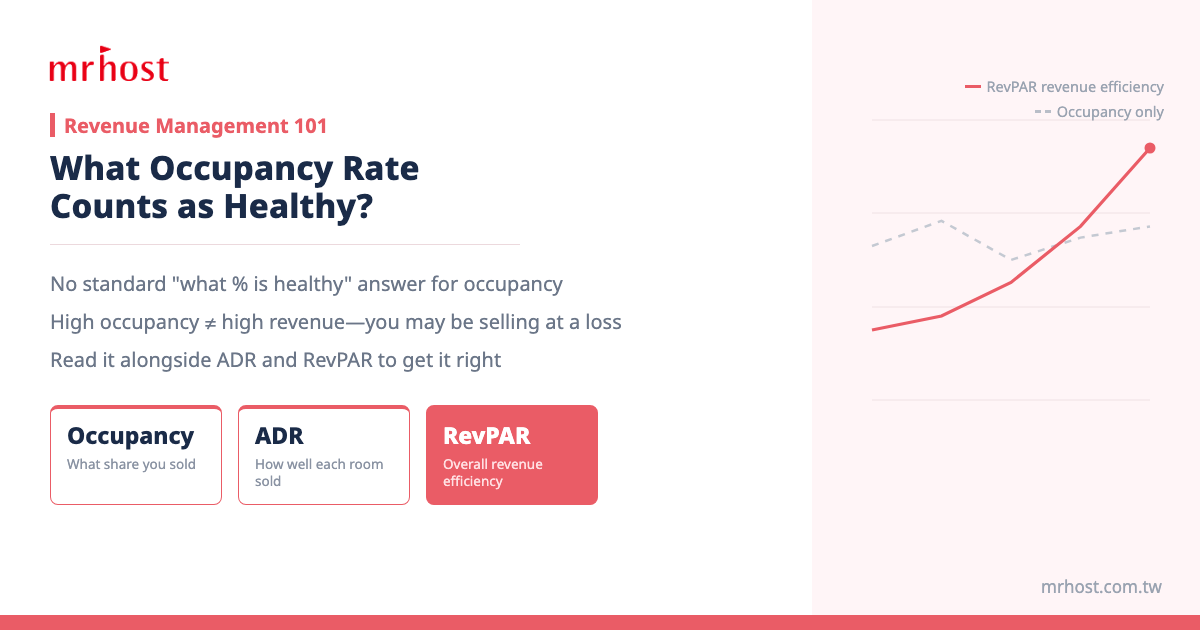
- There is no standard "what % is healthy" answer for occupancy; it depends on location, season, and cost structure
- A high occupancy rate does not equal high revenue——if it's bought by slashing room rates, you may actually be selling at a loss
- To judge whether occupancy is healthy, read it alongside Average Daily Rate (ADR) and Revenue per Available Room (RevPAR)
- What you should really pursue is not "the highest occupancy," but the balance point with the highest RevPAR (overall revenue efficiency)
- Rather than asking "what occupancy is good," build your own benchmark using the past 12 months of data, then compare against competitors with similar conditions
1. What Occupancy Rate Counts as Healthy? The Conclusion First: There Is No Standard Answer
"What occupancy rate counts as healthy?" is one of the questions hoteliers ask most. The answer may be surprising: there is no standard number that applies to every property.
The reason is that the "healthy value" of occupancy varies dramatically with several conditions:
Location. Urban business hotels, scenic resort hotels, and mountain properties with a pronounced off-season have wildly different reasonable occupancy rates. Applying someone else's number to yourself means little.
Season. For the same property, the reasonable occupancy rate in peak season and off-season is inherently different; measuring the whole year with a single number is not reasonable.
Cost structure. The variable cost per room (cleaning, amenities, utilities, labor) differs, so the lowest acceptable selling price and occupancy floor differ too.
So rather than asking "what % is healthy," a more practical question is: "Given the conditions of my property, does my occupancy rate combined with my room rate maximize overall revenue?"
2. Why You Shouldn't Look at Occupancy Alone: 3 Reasons
Occupancy is intuitive and easy to understand, but looking at it alone leads to misjudging your operating condition. There are three reasons:
Reason 1: A high occupancy rate may be bought by "selling at a loss." Push room rates low enough and occupancy will naturally rise. But if the selling price is below the level it should be, you are trading profit for occupancy——the rooms are full, but revenue drops.
Reason 2: Occupancy can't reveal "pricing power." Occupancy only tells you "what share you sold," not "how well each room sold." Two properties both at 85% occupancy with a notable gap in Average Daily Rate (ADR) will have very different revenue.
Reason 3: Occupancy alone cannot judge revenue efficiency. What truly measures a property's overall room revenue efficiency is RevPAR (Revenue per Available Room), which combines occupancy and room rate. Looking at occupancy alone means seeing only half the picture.
3. A Healthy Occupancy Rate Must Be Read Alongside These Two Metrics
To judge whether occupancy is healthy, you can't look at it alone—you must read it together with two other revenue metrics:
Average Daily Rate (ADR). The average price of each room sold, reflecting your pricing power. High occupancy but low ADR may mean room rates are set too conservatively, or discounts are too deep.
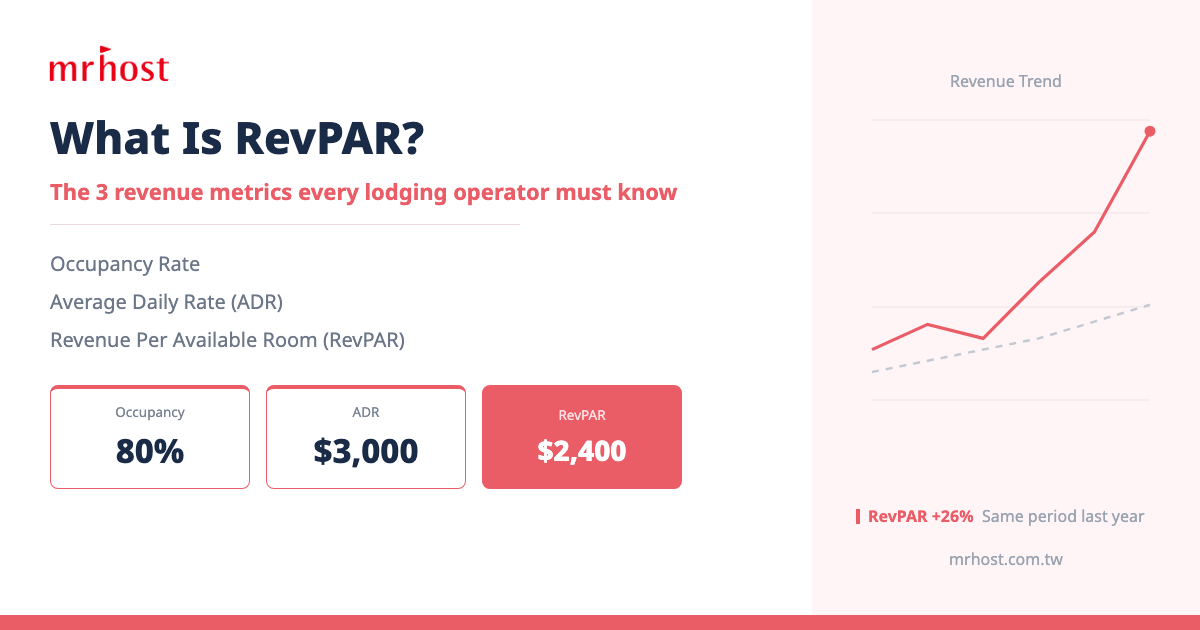
Revenue per Available Room (RevPAR). Calculated as "ADR × occupancy," it combines "how much you sold" and "how well you sold." It is the most comprehensive metric and the key to judging whether occupancy is healthy——
For example, Property A has 90% occupancy and ADR of NT$2,000, so RevPAR is NT$1,800; Property B has 75% occupancy and ADR of NT$2,800, so RevPAR is NT$2,100. B's occupancy looks "worse," but the revenue per available room is actually higher. This shows: the level of occupancy is not the point; whether you can maximize overall revenue is.
(For the definitions and calculation methods of these three metrics, see the article "What Is RevPAR? The 3 Revenue Metrics Every Hotelier Must Know," linked at the end.)
4. How to Find the Healthy Occupancy Rate for "My Property"?
Since there is no universal standard, the practical approach is to build your own benchmark and adjust it dynamically:
Step 1: Build a benchmark using the past 12 months of data. Review your own occupancy, ADR, and RevPAR over the past full year, separating the differences between peak/off-season and weekdays/weekends. A complete year is needed to cover a full peak-and-off-season cycle, and this is your basis for judging the "normal range."
Step 2: Compare against competitors with similar conditions. Use three criteria——location, hardware/software grade, and operating capability——to identify the peers travelers actually compare you against when booking, and see where your level falls. Comparing against properties with very different conditions is meaningless.
Step 3: Use RevPAR rather than occupancy as the target. Set the operating goal as "keep RevPAR within a reasonable range and improve it steadily," rather than "drive up occupancy." Raising ADR in peak season to maximize revenue and grabbing bookings in off-season to raise occupancy are both strategies serving the same purpose——maximizing overall revenue.
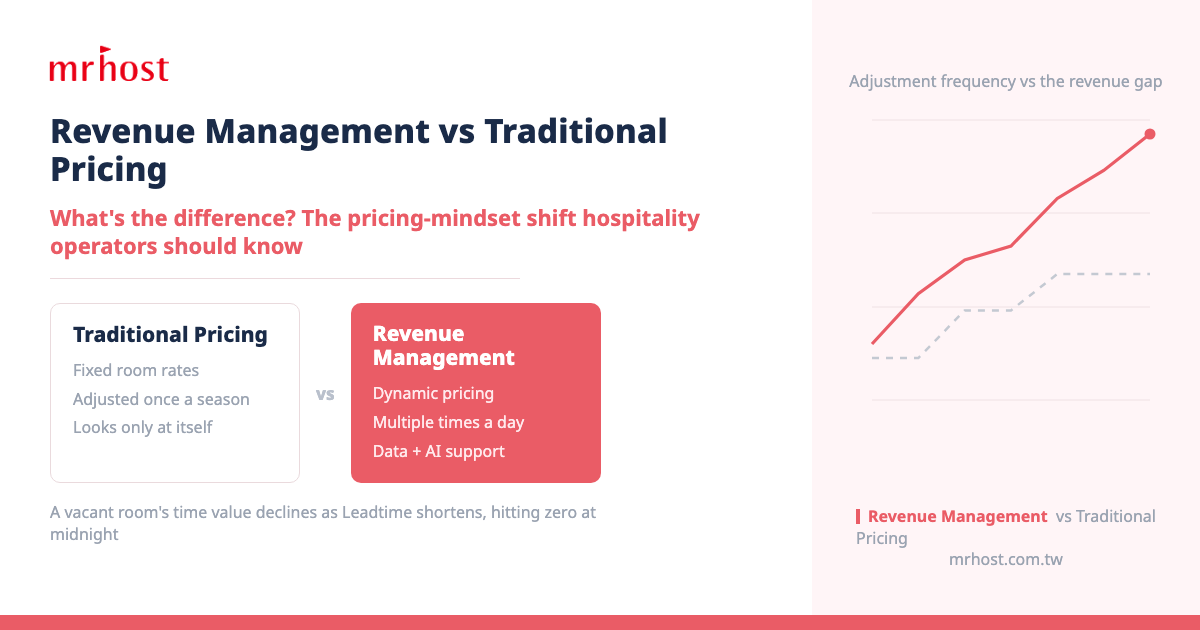
Step 4: Let room rates adjust dynamically. A healthy occupancy rate cannot be achieved by setting one fixed room rate; instead, let room rates float with demand, competitors, and remaining inventory. This is also where dynamic pricing systems and revenue management services add value——continuously adjusting based on real-time data to keep occupancy and ADR at the optimal balance point simultaneously.
5. Who Most Needs to Rethink Their Occupancy Mindset?
The following types of hoteliers especially deserve to rethink the question of "what occupancy rate is healthy":
- Hotels that long treat "driving up occupancy" as the only goal: may be trading profit for occupancy without realizing it
- Hotels with large peak/off-season swings: measuring the whole year with a single occupancy number easily leads to misjudgment
- Hotels used to judging business by "full house": a full house doesn't mean earning the most—look at RevPAR
- Hotels evaluating whether to cut rates to grab occupancy: calculate the impact on RevPAR and profit before cutting rates
(B&Bs with similar room types and scale can apply the same concepts.)
Frequently Asked Questions (FAQ)
Q: What occupancy rate counts as healthy?
A: There is no standard number that applies to every property. A healthy occupancy rate depends on the property's location, season, and cost structure, and varies with peak and off-season. Rather than asking "what % is good," it's more practical to build a benchmark using your own past 12 months of data and confirm whether, with occupancy combined with room rate, overall revenue (RevPAR) is maximized.
Q: Is a higher occupancy rate always better?
A: Not necessarily. If high occupancy is bought by slashing room rates, the revenue per room may actually drop, even below cost. 100% occupancy doesn't mean earning the most——the point is whether RevPAR (Revenue per Available Room) is maximized.
Q: Which metrics should occupancy be read alongside?
A: Alongside Average Daily Rate (ADR) and Revenue per Available Room (RevPAR). Occupancy shows "what share you sold," ADR shows "how well each room sold," and RevPAR combines the two—the most comprehensive metric for measuring overall revenue efficiency. Reading all three together avoids misjudgment.
Q: What should I set my occupancy target at?
A: Rather than setting a fixed occupancy target, set the goal as "keep RevPAR within a reasonable range and improve it steadily." Raising ADR in peak season and grabbing bookings to raise occupancy in off-season are both meant to maximize overall revenue, not to simply chase a certain occupancy number.
Q: With limited staff, I can't constantly watch these metrics—what should I do?
A: You can leverage dynamic pricing systems and revenue management consultants. The system can automatically adjust room rates based on real-time data and keep occupancy and ADR at a balance point, while consultants can help interpret metrics and devise strategies, so operators don't need to watch the board every day themselves.
This article was written by the mrhost Revenue Management team. mrhost provides hospitality revenue management consulting services, helping hotels and B&Bs in Taiwan and the Asia-Pacific region boost revenue and competitiveness.