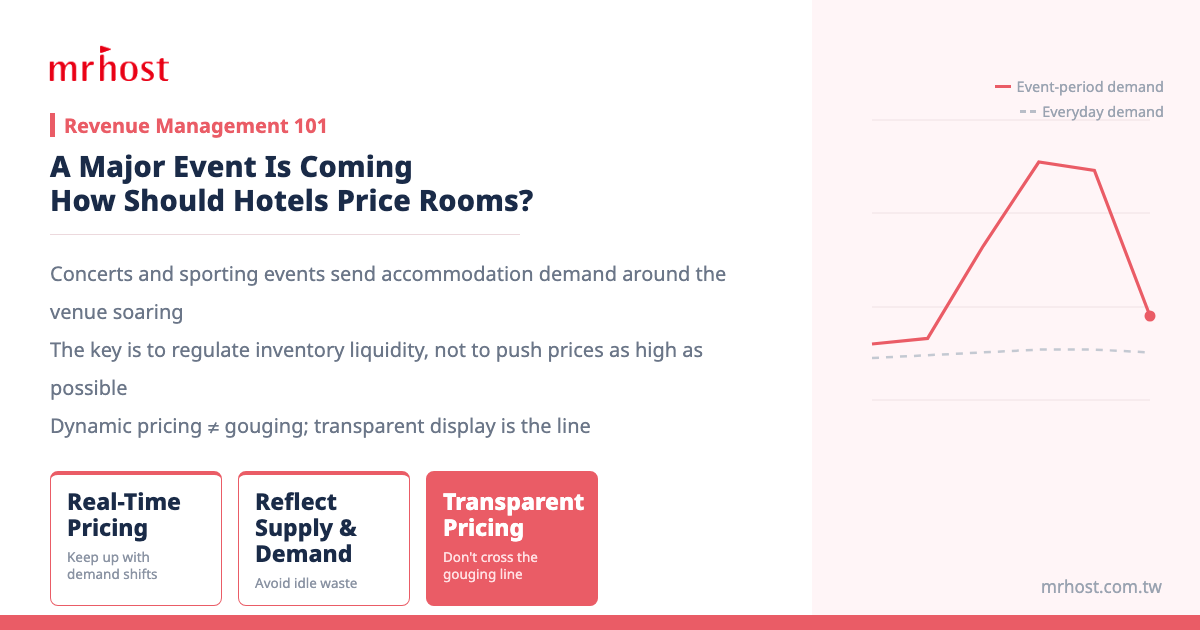
Whenever a major concert, international sporting event, or large exhibition takes place, hotel demand around the host venue spikes within a very short window—it is common to see "rooms around the venue sold out within hours of the location being announced." Faced with such a demand surge, what a hotel really needs to do is not "push prices as high as possible," but use revenue management to regulate the liquidity of its room inventory—letting rooms flow, at the right time and at prices that reflect genuine supply and demand, to the travelers who truly need them, while avoiding the twin waste of empty rooms or rooms snapped up in an instant. This article explains how hotels can regulate room rates during major events, and clarifies the line between "dynamic pricing" and "price gouging."
Key Takeaways
- Accommodation demand for major events concentrates around "the venue vicinity + the few days before and after the event," and often surges the moment the event is announced
- The role of revenue management in major events is to "regulate inventory liquidity," not simply to raise prices—letting rooms flow to the travelers who need them most
- Pricing too high and leaving rooms empty is one kind of waste; pricing too low and being snapped up, so the travelers who truly need a room cannot book one, is another
- Dynamic pricing (transparently displayed, reflecting supply and demand) and price gouging (no honest pricing, on-site overcharging) are two different things; the latter harms both travelers and the brand
- Demand shifts quickly during major events, so room rates must be adjustable in real time and repeatedly—this is where a dynamic pricing system shows its value
1. A major event is, above all, a test of "inventory regulation"
Major events affect hotels far more sharply than ordinary low and high seasons. A concert or sporting event drawing tens of thousands of people creates, on specific days and in a specific area, accommodation demand far beyond the everyday norm—and this demand is highly concentrated: concentrated around the venue, and concentrated in the day or two before and after the event.
Faced with such a demand surge, the first thing many people think of is "this is a chance to raise rates." But if you understand it only as a "chance to raise prices," it tends to backfire. A more accurate understanding is this: a major event is a test of inventory liquidity—the rooms you hold are limited inventory that "expires" (if tonight's room is not sold, that night's value drops to zero), and the task during a major event is to let this inventory flow smoothly, at prices that reflect genuine supply and demand, to the travelers who need it most.
Seen this way, both kinds of mispricing are in fact a "waste of resources":
Prices fail to keep up with demand, and rooms sell out too early. If you fail to notice a major event on certain days and keep selling at everyday rates, your rooms will be snapped up fast. On the surface business looks great, but it means the rooms did not flow to the travelers who "need them most and are willing to pay an appropriate price for these days"—they may be intercepted by scalpers and resold, while people who genuinely want to attend the event and are willing to pay reasonably cannot book. Inventory flowing away too fast and too cheaply is also a kind of waste.
Prices too high, rooms left empty. Conversely, if you push prices too high all at once, beyond a reasonable range, or adjust too late, the rooms go unwanted instead. The time value of an empty room drains away every day, and you lose the chance to sell the room at the optimal moment—a revenue loss for the hotel, and a waste of accommodation resources for society.
What revenue management does is, between these two extremes, keep prices tracking genuine supply and demand and maintain a healthy flow of inventory.
2. What does accommodation demand for a major event look like?
To regulate well, you first need to understand the demand characteristics of major events. Take Taiwan's recent major concerts—TWICE playing three consecutive nights at the Taipei Dome in March 2026, followed in the second half of the year by aespa (August, Taipei Dome) and BTS (November, three consecutive nights at Kaohsiung National Stadium)—the accommodation demand for such events shares several common traits:
Demand starts rising "when the event is announced," not in the event week. Many attendees start booking accommodation the moment the venue and date are announced, or even the instant tickets go on sale. Media reports often note that "rooms around the venue are swept clean within hours of the location being announced," showing that demand begins far earlier than the event day itself. For hotels, this means "waiting until the event is almost here to react" is usually already too late.
Demand is highly concentrated around the venue and specific transit nodes. Take Kaohsiung's World Games Main Stadium: hotels near MRT stations and major transfer points book up earlier than those farther away. The closer to the venue, the more concentrated the demand tends to be.
Out-of-town and overnight demand increases. Major events often attract travelers from other cities, and even from abroad, who need to stay overnight and frequently extend their trip by a night or two for sightseeing. This means demand can appear in the day or two before and after the event, not only on the event night.
Ticketing mechanisms such as real-name registration affect the rhythm of demand. For example, BTS's Kaohsiung shows used real-name ticketing, and the timing of ticket purchase and itinerary confirmation shapes when travelers book rooms. Knowing an event's ticketing schedule helps you judge when accommodation demand will kick off.
Once you understand these traits, the regulation strategy is no longer just "raise prices," but "position early when demand starts rising, and let inventory flow at a reasonable pace and price according to how concentrated demand is."
3. When demand surges, how should prices be regulated reasonably?
Continuing the principle from the article on "special event surcharges," price adjustments during major events should not be decided on gut feeling alone, but based on two factors:
Your own demand intensity. Look at the remaining room count for these days, the booking pace, and the lead time of incoming bookings. If the event is still some way off but rooms are already booking fast, demand is strong; otherwise, stay conservative.
Competitors' real-time room rates. How comparable hotels in the same event district price their rooms is an important reference. Competitors' rates also fluctuate during a major event, so you need to keep up in real time rather than rely on everyday market judgment.
Judging the two together, the goal is to land prices at the balance point that "reflects genuine supply and demand while staying within travelers' acceptable range"—so rooms flow smoothly without sitting idle, and you do not push travelers to competitors by pricing too high. Here it is worth remembering the reminders from "special event surcharges": raising prices too far drives travelers to competitors (prices must still match travelers' acceptance), and adjusting too late misses the point where demand starts rising (demand for major events often surges before the event).
In other words, reasonable regulation is not "go as high as you can," but "let prices honestly reflect supply and demand for these days."
4. Drawing the line: dynamic pricing ≠ price gouging
When discussing room rates for major events, one line must be made clear—and this is key to a hotel protecting its own brand.
With every major event, social news often carries reports of "operators jacking up prices during concerts and being inspected and fined by the authorities." What must be distinguished is that dynamic pricing—adjusted by market supply and demand and transparently displayed in advance—and last-minute gouging or on-site overcharging are two completely different things:
Correct dynamic pricing: room rates adjust with supply and demand, but the traveler sees and agrees to the price at the moment of booking; the price is open, transparent, and grounded. This is a normal market mechanism that hotels use to regulate inventory liquidity.
Price gouging: not honestly displaying prices, inventing pretexts to overcharge on the spot, or adding charges after a booking is already confirmed. Such behavior may breach relevant regulations and draw penalties from the authorities, and even more, it leaves negative reviews that seriously damage a hotel's long-term brand.
For travelers, the former is "I clearly know and accept this price before I book," the latter is "being forced to accept opaque overcharging"—worlds apart in perception. For the hotel, gouging may bring a little extra in the short term, but the negative reviews, inspections, and brand damage make it a net loss in the long run.
True revenue management seeks a balance between short-term revenue and long-term brand trust: using transparent, reasonable pricing to regulate inventory liquidity, so travelers feel it is "fair" and are willing to return, rather than a one-time fleecing. This is also the most fundamental difference between professional revenue management and "opportunistic gouging."
5. During regulation, room rates must respond "in real time, repeatedly"
Demand shifts faster during a major event than usual—it can change within a single day because of added show dates, ticket releases, or updated transit information. The requirement this places on pricing is: room rates must be able to follow supply and demand in real time, even multiple times within a day.
This is also the most demanding part of regulating a major event. You must simultaneously watch the remaining room count, competitors' rates, and the latest event-related news, and adjust prices for specific future days room type by room type—a huge workload that is hard to sustain by manual daily operation.
A dynamic pricing system is designed precisely for this scenario: it can automatically adjust room rates based on real-time data, factoring in "occupancy, safe booking-pace attainment, competitors' rates, and special events," updating multiple times within a day to keep inventory liquidity in a healthy state—neither snapped up too cheaply because of a slow response, nor left idle because the price is stuck at a high point. Paired with a revenue management consultant to interpret the demand rhythm of an event, a hotel can face major events more calmly and more gracefully.
6. After the event ends, don't forget the "wind-down"
Pricing for a major event does not end when the event ends. A common oversight is that event-period prices are not adjusted back in time and carry over to the days after the event—days with no special demand—leaving rates too high on those days, unwanted, with rooms sitting empty again—back to the problem of "wasted idle inventory."
The ideal approach is to set the "exit" during planning—after the event ends, prices revert to normal market demand, and slow days that should chase bookings go back to the strategy of chasing bookings and raising occupancy, keeping inventory flowing healthily. One benefit of a dynamic pricing system is that this reversion can also run automatically based on data, without manually watching and changing it back day by day.
7. Which hotels most need to nail inventory regulation for major events?
- Hotels located near large venues: areas around concert and sports venues (such as the Taipei Dome and Kaohsiung's World Games Main Stadium) are where demand is most concentrated
- Hotels near transit hubs: areas around stations and MRT transfer points are often the first choice for out-of-town travelers
- Hotels in cities that frequently host major events: cities with frequent events have several demand peaks throughout the year that need regulating
- Hotels with many room types listed on multiple platforms: there are many price entries to adjust in sync during regulation, making system and professional support most needed
(Guesthouses similar in room type and scale can apply the same strategies.)
Frequently Asked Questions (FAQ)
Q: During a major event, how much can a hotel raise its room rates?
A: There is no fixed multiplier. The reasonable range depends on your own demand intensity (remaining rooms, booking pace) and competitors' real-time rates, and must match travelers' acceptance. The point is not "how high you can go," but letting prices honestly reflect supply and demand for these days, so rooms flow smoothly to the travelers who need them while avoiding empty rooms sitting idle.
Q: Will raising prices during a major event be deemed gouging and result in a fine?
A: It depends on how you do it. Prices adjusted by supply and demand, transparently displayed in advance, and clearly known and agreed to by the traveler at booking are correct dynamic pricing; failing to display prices honestly, overcharging on the spot, or adding charges after a booking is confirmed is gouging, which may breach regulations and harm the brand. The key is "transparent and grounded," not whether the price itself has changed.
Q: When should I start adjusting room rates for a major event?
A: The earlier you pay attention the better, usually the moment the event details and dates are announced and tickets go on sale. Accommodation demand for major events often surges before the event, and "rooms around the venue selling out fast once the location is announced" is a common phenomenon. React too late, and inventory tends to be booked away before it reflects demand.
Q: My hotel is some distance from the venue—can it still benefit from a major event?
A: There's a chance, but to a different degree. Hotels closer to the venue and closer to transit nodes usually see demand surge earlier; hotels farther away may catch the spillover demand "after the near-venue hotels sell out," or attract budget-conscious travelers willing to walk a bit farther. Judge by your own location and booking data from past events.
Q: Do room rates for a major event need to be adjusted several times a day?
A: Ideally, yes. Demand shifts quickly during a major event and can change within a day because of added show dates or ticket releases, so room rates should keep up in real time to keep inventory flowing healthily. Such high-frequency adjustment is hard to sustain manually and is usually handled by a dynamic pricing system.
This article was written by the mrhost revenue management team. mrhost provides accommodation revenue management consulting services, helping hotels and guesthouses across Taiwan and the Asia-Pacific region boost revenue and competitiveness.